
NEW WINGS OVER PENHOLD
F/O V. VENHOLA
(Republished from the July 1954 issue of the Central Alberta Air News, RCAF Station Penhold)
(RCAF.info note: there are a few spelling errors that have been pointed out in the text below that dates back to the original publication. As the correction improves the readability and accuracy, I have corrected these errors. I have placed an “*” at the end of any corrected sentences. I will add a footnote with the original text.)
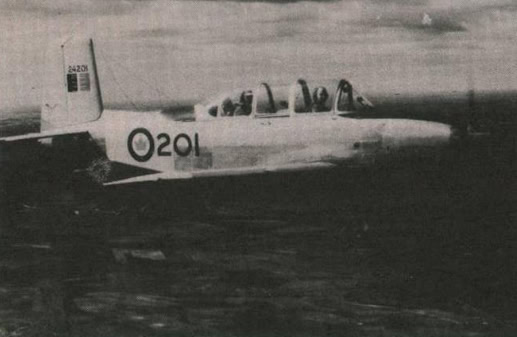
Local residents have probably noticed a new type of training plane, silver in colour, in the skies of late. This is the Canada Car & Foundry T-34 Mentor. The new plane was publicly demonstrated at the Air Force Day show on June 12th, and the performance was neat and impressive. Incidentally, Mentor means “a wise and faithful counsellor.”
The T-34 is a two-place single engine trainer built under license from Beech Aircraft Corporation.* The design meets the requirements of sturdiness, and safety of a primary trainer. It possesses many of the flight characteristics and operating systems of a high speed jet plane. Even the layout of the cockpit will make it easy to convert to a jet plane. An interesting feature of the plane is the tri-cycle type of landing gear, which makes for easier and better controlled landings. The landing gear is fully retractable and full size flaps are employed to enable slow and steep descents for landing.
From the instructor’s point of view from the back seat the visibility is excellent compared to the Harvard. A large bubble type canopy with no obstructions in between the seats will add greater safety in all-round flying.
A proven, reliable engine is used of 225 horse-power at 2600 rpm at sea level. It is the Continental six cylinder, air cooled, horizontally opposed engine. Slight additional thrust is obtained by an augmentor tube exhaust system. Cooling of the engine is automatically controlled by a baffling system operated by a venturi in conjunction with the augmentor tube exhaust system. No cowl flaps or other cooling accessories are required.
The radio equipment consists of a VHF set (one receiver and three transmitters) and a range receiver operating in the 190-550 Ke band. Inter-phone between the two cockpits is provided for instructor to student conversation.
Finally, here are the performance figures:
- Landing speed – 55 Kts
- Climbing – 90 Kts
- Maximum speed – 243 Kts
- Cruising – 125 Kts
- Stall – 45 Kts
- Slow rolls – 115 Kts
- Glide – 90 Kts
- Loops – 150 Kts
- Roll off the loop – 160 Kts
- Maximum Weight for landing – 2900 lbs
The airplane carries 50 gallons of fuel. The engine uses approximately 7 gallons per hour. This gives an endurance of about 7 hours at 120 Kts cruising, and giving a still air distance of approximately 840 nautical miles. It is estimated that the T-34 will save 150,000 gallons of aviation fuel over a 5-year period compared to a Harvard — both being utilized 5 hours a day.
The T-34 will be on special trial here at Penhold to prove its worth as a trainer before finally being accepted by the RCAF.
Error correction Footnote(s):
* – The T-34 is a two-plane single engine trainer built under license from Beach Aircraft Corporation.