
THE C-119
by F/L P.F. HOPE
(Republished from the October 1954 issue of the Central Alberta Air News, RCAF Station Penhold)
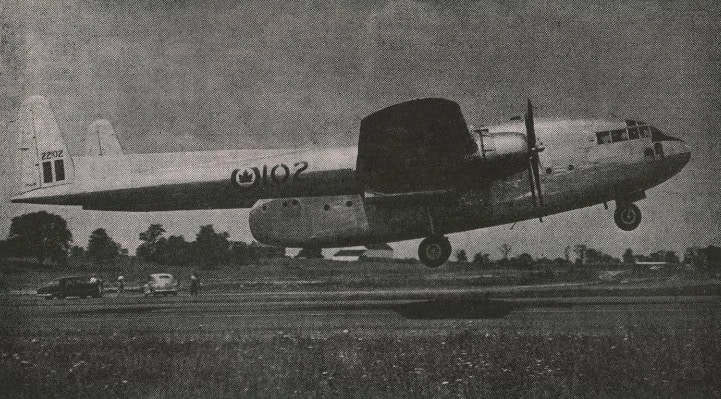
Canadian Joint Air Training Centre at Rivers and 435 Squadron at Edmonton were the first R.C.A.F. stations to house the Boxcar.
The C-119 is built by the Fairchild Aircraft Company situated in Hagerstown, Md. The aircraft has two 3,250 h.p. Wright Cyclone engines that incorporate water injection giving 3,500 h.p. per engine for short take-offs. The propellers are four-blade Hamilton, standard hydromatic, full feathering and reversing for short landings. The engines produce 80% power in reverse pitch. Almost everything about the aircraft is electrical except the doors. The fuselage or the “Pod” is in three parts. The cargo compartment is capable of carrying 42 fully equipped paratroopers plus 10,000 lbs. of equipment, or 62 fully equipped soldiers and, in emergency, 76 personnel. The paratroopers’ exit is made via two doors in the rear. Heavy dropping such as jeeps, howitzers, etc., is accomplished by removing the clam shell type doors at the rear. Para-bundles are sent on their way by a passage similar to bomb bay doors at the front of the cargo compartment.
The crew’s compartment is reached by climbing a ladder from the aft section. First we pass the crew chief’s office, then the radio officer and navigator’s working tables which are the last word in equipment and position. The navigator even has a True Airspeed Indicator that is as accurate as a computor. The radio officer to tune his set merely moves a selector to the frequency desired and ’lo and behold, no off-frequency transmitting.
The front office, holding the easy chairs of the president and the vice-president, is a pilot’s dream. The seats are of the five position variety and have the radio console between them. Because the pilots are so far ahead of the engines only slightly above normal voice modulation is necessary. The throttle quadrant is at the top of the radio console and the propeller instruments are so many that the one check takes as long to do as the full engine check on the Expeditor. It is not necessary to juggle the pitch levers as there is only one master lever and a push button synchronizes the propellers as one electrically slows off the other. The pilots’ instruments are all electrical, giving more accuracy. All the instruments that the pilots may use are within easy reach and are strategically placed. To illustrate the simplicity of the pilots’ position, the automatic pilot is the best example.
It is activated by a switch on the console and if a turn is desired any rate of bank may be achieved by one finger which automatically puts on rudder and elevator, the auto pilot may be disengaged by a push button on the control column wheel.
The third compartment is upstairs from the pilots and houses the auxiliary power unit and all the motors for the heaters. This compartment is also ideal for placing at least three sleeping bags for a long trip.
The engine checks are conventional but very closely noted such as the tolerance for a magneto drop in 30 R.P.M. which is more easily noted by a torque meter than by a tachometer.
The de-icing is of the type that is noted on the more modern aircraft of today. Six combustion type heaters are incorporated to supply heat to the wings and tail sections, the intensity of the heat depending upon how many heaters are used. If icing conditions are very bad then all the heat supplied to the compartments is used and electric flying suits may be brought out.
The undercarriage is the tricycle type with the mains having tandem wheels. The undercarriage is stressed for a maximum gross landing weight of 72,000 lbs.
The fuel used is 115/145 and when the Flying Boxcar first arrived in Canada only a few stations had this type of fuel on hand (thus one of the transport jobs took thirteen days to go to Halifax and back because of the shortage of fuel stop-over points. Eight of those thirteen days were in Montreal and the crew were quite put out, as the reader can imagine. Those 426 crews are awful at lies and poker dice.)
The aircraft was designed to do a job of tactical work for a tactical air force and seems to be proving itself by the amazing air lifting roles it is doing. The air force by acquiring this type of aircraft has truly helped the army to become three dimensional.