
The Flying Elephant
The Story of 436 Squadron
(Republished from the 2 September 1971 issue of Contact)
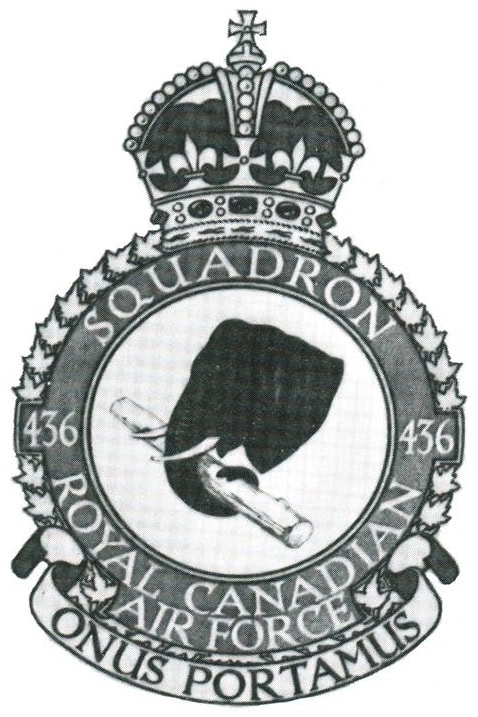
The summer of 1944 saw the Allied armies on the offensive in many theatres of war in which were included the invasion of Normandy and — 6,000 miles away — the hard fought campaign in India and Burma to drive back the Japanese invaders. In this latter theatre the Royal Canadian Air Force’s number 436 Squadron was born.
The problem in India and Burma was one of transportation and logistics — a need to supply the Allied 14th army at the front lines in Burma across a 2,000 mile supply line from depots in India and Pakistan. The trip, by primitive railroad and foot-Path was taking two months in some instances.
Air power held the answer and with the formation of a major scale air transportation service in south-east Asia, two new Canadian Squadrons were created; No. 435 “Chinthe” and her sister Squadron No. 436 “Elephant”. It was on 7 September, 1944, to be exact, that 436 squadron was authorized to form, but not until 9 October did the body corporate gather at Gujrat, a fighter base high in the Punjab of India near the Kashmir border.
With the arrival of ground personnel on 21 October the embryo unit became a squadron in fact as well as in name. On 31 October the first CO, Wing Commander R.A. Gordon, arrived and hard on his heels were the flight commanders, Squadron Leaders R.L. Denison and J.K. Herriot. The original member of the Squadron was its adjutant, Flight Lieutenant R.S. McCartney.
Equiped with Dakota Mk3 and 4 aircraft, the squadron trained for its role of air transportation in direct support of the units of the 14th army. Belonging to 229 group, it was part of an RAF-USAAF-RCAF military airline known as “Combat Cargo Task Force”. By the first week of December they had carried out their first assignment of moving No. 117 (RAF) Squadron from Bikram to Hathazari, both in East Pakistan. Their first task at the front lines of war involved an air-drop of supplies at Shwebo, Burma in support of the ground drive to Mandalay on the 15th January 1945.
From that auspicious start to the end of the war, 436 continued to set new records for pounds of cargo and number of passengers flown. In a one month period, during the dreaded monsoon season the squadron flew 1238 sorties and carried almost 8,000,000 pounds of freight as well as 1130 passengers and 204 casualties. This was all done in spite of the enemy and the living conditions – but most of all, perhaps, in spite of the weather.
In fact, the weather was so bad that during the month of June, 1 945 while based in Ramtree, Burma they were subjected to 45” of rain. Unfortunately, this downpour had forced the cancellation of many sorties and other flights that had managed to get airborne had been diverted to other airfields because Ramtree had become a sea of mud. To make matters worse, the USAF had closed up its meteorological service and it had not yet been replaced by the RAF. Unable to combat the monsoon on the ground, the squadron chose to fight it in the air by inventing a substitute weather system of their own. So was born “Watchbird”, the brainchild of the CO, W/C Gordon, which was to ultimately win him the DSO.
Watchbird was a simple but surprisingly effective system of airborne weather surveillance that involved an aircraft taking off early in the day and devoting itself to watching and reporting the weather over a designated area. The aircraft would be relieved during the day so that continuous watch was maintained. Word of the system spread throughout the air group and beyond. Soon many other squadrons and units were monitoring Watchbird’s broadcasts and making operational use of them.
Exploits of derring-do on the squadron are too numerous to mention. Even though 436 was nor formed until the last year of the war one Distinguished Service Order and 18 Distinguished Flying Crosses were awarded its men. The squadron logged 32,000 hours of flying over more than 4,000,000 air miles. They had airlifted 29,000 tons of food, military necessities, and “treats and comforts” among other things to sustain soldiers and civilians alike at the front lines of war. In addition they had transported more than 15,000 troops, casualties and passengers.
Having no protective armour other than sidearms, the aircrew were wide open to enemy ground fire and aerial attack. They faced the constant threat of forced landing or bailout over impenetrable jungle inhabited by wild animals, unpredictable natives and a merciless enemy. On one-half of their flights they were assailed by the most formidable foe of all — the tropical monsoon with its towering thunderstorms, torrential rains, low cloud and reduced visibility. They had no respite, until the 31st August, 1945 when for them and their sister unit, 435 squadron the war ended.
The squadron then moved to Down Ampney in Glouscestershire, England under its new Commanding Officer W/C R.L. Denison. Infused with new blood, the squadron regrouped and reorganized and before long had started a second career in Europe carrying troops, casualties, mail and supplies in a sphere of operations that expanded to embrace virtually every key air terminal in Europe. But these activities were to be short lived. One month after winning an award for the most ton-miles flown without accident in the Air Transport Group, the squadron flew home to Canada to be disbanded. The flight that Dress on the 22nd of June 1946 was the Squadron’s last in the World War II era.
But there was to be a third herd of Elephants!!!
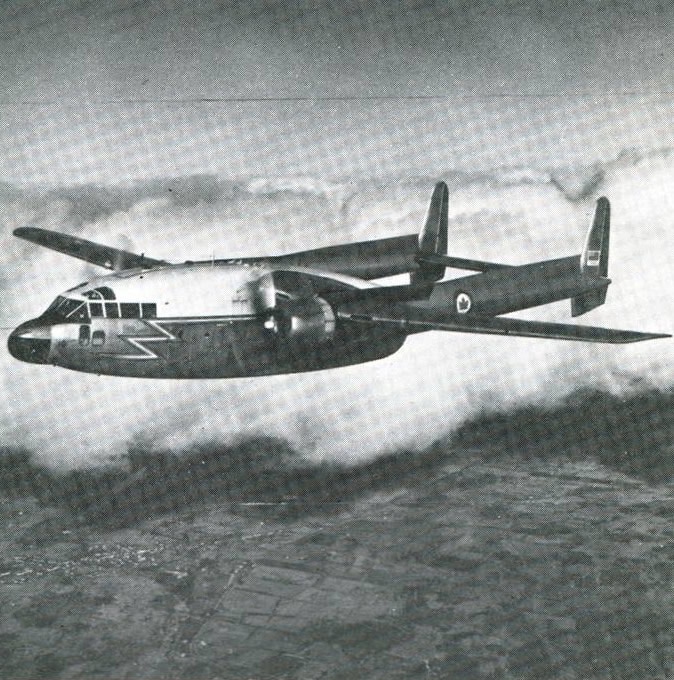
In the early 1950’s, attendant upon the RCAF’s increased responsibilities resulting from Canada’s membership in the United Nations and the North Atlantic Treaty Organization there arose a requirement for greater air transport capabilities. Accordingly, 436 was authorized to reform at Dorval, P.Q. effective 1 April, 1953. To discharge it’s duties the Squadron was given the C-119 Boxcar to replace the venerable Dakota as the official workhorse. Never was an aircraft better named. With a fifty percent increase in range and a twenty-five percent increase in cruising speed, the Boxcar could do the work of several Daks.
Given their first assignment only twelve days after being reformed, the Elephants were soon active in all specific phases of their role. Ration runs and seasonal resupply operations, army co-operation exercises and airlifts, mercy missions, training and test flights, air shows, a Coronation flypast are all indicators of the variety, if not the number, of the Squadron’s activities in the 1950’s. Trips across the Atlantic soon became regular occurrences with the establishment and maintenance of NATO formations in Europe.
The squadron was once again fated to move, this time because of a fire in one of the hangars at Dorval that destroyed an aircraft. On 1 July 1956, 436 moved to RCAF Station Downsview becoming the City of Toronto’s first regular service flying squadron.
Early in November of that year hostilities broke out between Israel and Egypt. Canada was to assist the United Nations Emergency force sent to police the conflict by providing an air transport squadron. Four of the Flying Boxcars were soon flying out of a new home base at Capodichino, Italy on a thrice weekly, 1,300-mile shuttle flight to Abu Suweir, Egypt with troops, equipment and supplies, Ironically, when the UNEF was withdrawn 10 years later, it was 436 aircraft that helped do the job.
The years from 1957 to 1960 saw the Elephants maintain an increasingly heavy schedule in the transport-support role. A prime responsibility was the resupply of remote Arctic and sub-Arctic bases, including the spring and autumn resupply operations at Isachsen, Mould Bay, Eureka and the world’s northern-most habitation at Alert. These occasioned some of the most intensive flying of the post war period for the squadron. On the resupply of one of these bases a detachment of some 100 personnel was stationed in northern Greenland for nearly three months to fly in some 2,000 tons of supplies including 5,200 barrels of fuel.
Perhaps the most appreciated supply drops were the Christmas para-drops to DEW line stations and other snow bound outposts throughout the Arctic archipelago.
Another top priority commitment was the fulfillment of army airborne requirements. In para-drop and other purely
tactical exercises the Elephants worked in close co-operation with army regiments, particularly the Royal 22nd and the RCR’s; so much so that in June 1959, in recognition of their long association, the “Van Doos” granted all officers of the squadron honorary lifetime memberships in their mess.
While airlifts in support of surveys and scientific expeditions had taken the Elephants north to the Polar regions, in September 1961 the Squadron’s operations were extended to the very heart of the Dark Continent as a detachment of two aircrews and a ground crew party with two C119’s was despatched to Leopoldville to assist in the internal-transport phase of the Congo airlift.
In August of 1964 the squadron moved from Downsview to Canadian Forces Base Uplands near Ottawa. Within a year the “Boxcars” were replaced by C-130E Hercules aircraft and almost immediately the role of 436 squadron changed from primarily domestic air transport to global air transport.
The Hercules enables 436 Squadron to airlift large payloads over long distances and into airfields that are unusable by most other large aircraft. (In fact the acquisition of the Hercules represented an increase of 98% in load carrying capacity and 83% in airspeed over the Boxcar). With these aircraft came a variety of new tasks for the squadron and intercontinental experience for its aircrew. Now, instead of exercises like “Rapid Step” in 1956 between Calgary and Halifax, 436 Squadron began air lifting airborne regiments in exercises such as “Polar Express” between Victoria and Norway or “Practorium Pans” between Trenton and Puerto Rico.
In the present day, “flexibility” is the key word on the Squadron’s role. During the past few years under the United Nations Flag, 436 Squadron Hercules have transported peace keeping troops and their supplies to Pakistan and Cyprus; oil into Zambia and food to Biafra. They have carried school supplies to the Caribbean and aid to the earthquake victims of Peru.
The Canadian Hercules have become & common sight at airports such as Nairobi, Santiago, Darwin, Singapore, Las Palmas and Hong Kong as almost monthly flights of the “300” series have carried out resupply of Canadian missions abroad. Last year one of these flights carrying Red Cross supplies was one of the first aircraft to land to land at Manila which was recovering from a tropical hurricane.
The regularly scheduled flights of 436 are just as varied. Usually there are two per week from Trenton or Ottawa to Lahr, West Germany taking supplies to Canadian NATO forces in Europe. The Squadron is responsible for weekly flights to Goose Bay. It also operates one of the Worlds most unusual scheduled flights. Regular as clockwork, once per week, Service Flight 85/86 travels to Thule Greenland and then to Alert, NWT, just 450 miles from the North Pole. It returns southward via Resolute Bay on the historic Northwest Passage.
The crews of 436 are still well known in the Arctic. Besides the weekly flight the Squadron is responsible for the yearly resupply of Alert. Called “Exercise Box top”, this operation sees aircraft and crews detached to Thule, Greenland where they take supplies coming off ship and shuttle them northward to Alert where the sea is never open to navigation. 436 crews are also involved in “Exercise New Viking” taking land force personnel on Arctic training. In addition, the Squadron maintains a crew on 24 hour call in case of a search and rescue mission in the north.
436 is also a “Tactical” squadron. The Hercules is capable of delivering heavy loads or troops by parachute and all crew are trained in paradrop procedures. Much of this activity is centred around Edmonton where the Canadian airborne regiment is located; however, once per month at least two aircraft are detached to Fredericton in support of the combat group there. In one exercise last year 436 took part in a totally Canadian, twelve-plane formation drop. It also participated in joint RAF and USAF para drop exercises.
Behind this flexibility there must be a strenuous continuation training program. Almost daily local “trainers” can be seen in the “circuit”. Each pilot and flight engineer must also spend time in the flight simulator, a sophisticated piece of ground equipment which flies almost identically to the real aircraft, and in which every conceivable emergency procedure is practised. And of course like all servicemen, the crew members are never free from those unending ground exams.
At present 436 (T) Squadron has 12 aircraft with 150 aircrew officers and men. Additionally, some 500 men carry out the daily aircraft maintenance. During 1970 alone the squadron flew over 17,263 hours and five million miles, transporting tons of freight, passengers, fuel and mail.
On August 11, 1971 436 Squadron ended its association with the nation’s capital and moved to Canadian Forces Base Trenton where no matter what the cargo is or where it’s going the Elephant will do the job and live up to it’s motto of “ONUS PORTAMUS” — We carry the load.