
The Tiger’s Lair
The Story of 424 Squadron
(Republished from the 2 September 1972 issue of Contact)
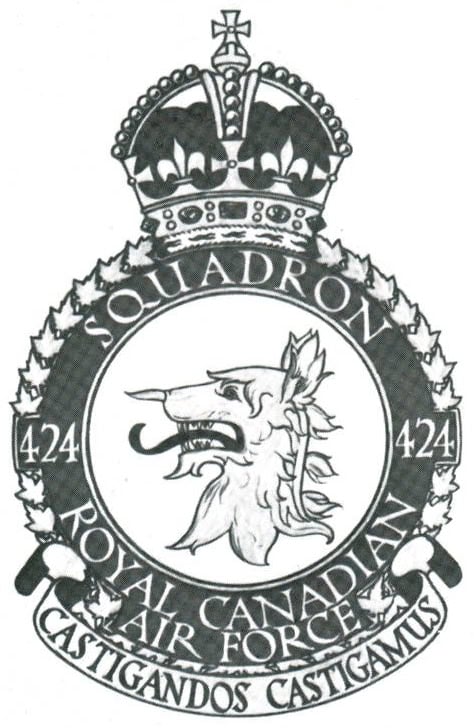
424 Squadron was formed at Topcliffe, Yorkshire, England on the 15th day of October, 1942 under Wing Commander (Air Vice Marshal) Henry M. Carscallen, DFC, of Hamilton. The City squadron was adopted by the Chamber of Commerce of the City of Hamilton.
424 Squadron began its life as a unit flying Wellington III aircraft in No 4 Group of Bomber Command, transferring to No 6 (RCAF) Group in January 1943 when the all-Canadian group came into being.
After an intensive training period, the Squadron took part in their first operational sortie against the German submarine base at Lorient. The target was successfully bombed and the reflection of the flames could be seen for 80 miles. This auspicious beginning, including an engagement with two enemy fighters, was followed by raids on several German industrial centres and submarine bases, such as Hamburg, Essen, Frankfutt and Mannheim.
Following the raid on the armament centre of Mannheim, 424 ceased for a time its raids over Germany and awaited transport to No 331 Wing in Tunisia, North Africa.
The men, aircrew and groundcrew alike, were billeted on the stone floor of an evacuated school, or in tents with some choosing to stay in their aircraft. Coping with the problems of accommodation, food, and a sea of mud, the squadron prepared for work. Their first raid was carried out on the night of June 27, 1943 against San Giovanni on the Italian mainland.
During the next few months, the squadron was actively employed in the all-out bombing campaign which softened the axis defences in Sicili and Italy preparatory to the Allied invasions. Raids were carried out almost every night on air fields, railroad centers, and lines of communication. On September 8th, 1943, the Squadron heard of Italy’s surrender and a month later was advised that it was returning to England.
424 Squadron, now well known as the “Tiger” Squadron, was stationed at Skipton-on-Swale and began conversion training on Halifax III aircraft.
Rejoining No 6 Group, the Squadron resumed its bombing role on German industrial cities. Their initial raid with this 4-engined Halifax bomber was carried out on the German capital, Berlin, on the night of February 15th, 1944.
After “D Day” targets included railway facilities serving the German army in France as well as enemy troop concentrations and V-1 rocket rocket launching sites.
In February, 1945, the Squadron was re-equipped with Lancaster aircraft and continued to pound German targets unti it took part in its last bombing raid on enemy coastal defences on April 25th, 1945. For a time the Squadron made a number of flights carrying liberated Prisoners of War to England and disposing of its surplus of bombs. The Squadron was stood down on October 15, 1945, three years to the day after it was organized.
The final entry of the Tiger war diary reads, “we are most proud, not of the Squadron’s exploits, many and noteworthy as they were, but of the spirit that has always supported it. No matter what the task or how heavy the losses a cheery comradeship had prevailed and doubtless will prevail in the future. A final word of acknowledgement to our Sponsors, the Chamber of Commerce, City of Hamilton. They have always had an understanding of our needs and have been both quick and generous in satisfying them. Thank you, City of Hamilton.”
Over the years, the Squadron was engaged in a wide variety of activities and exercises, taking part in search operations, providing mock attacks in civil defence exercises, and performing in air displays.
Under Air Defence Command, 424 Squadron took Part in extensive training programs in Ground Controlled Interception and rocket firing. An Important “first” for the Squadron was winning the MacBrien Trophy Shoot at Trenton in 1953. Another exercise saw Hamilton’s pilots score more than double the strikes of their nearest competitors in practise interception of overflying United States Air Force Bombers.
On October 28th, 1954, the squadron received their first T-33, ‘Silver Star” jet aircraft, and continued in a jet fighter role until 1956 when they were transferred to Training Command flying the twin-engined Expeditor aircraft.
In 1958, 424 Squadron was transferred to Air Transport Command where they flew both Expeditor and Otter aircraft in a light transport role.
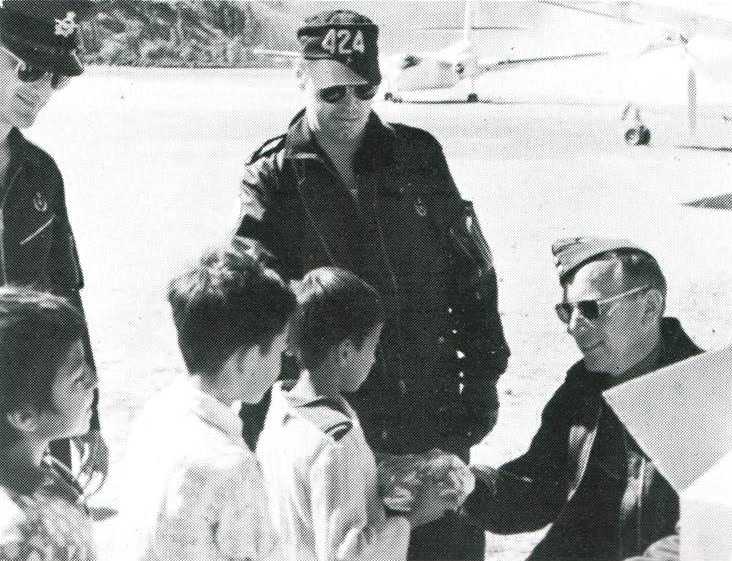
The Squadron continued operations in support of light transport duties and search and rescue until disbandment in 1964. The last 424 (auxilliary) Commanding Officer was Wing Commander G.W. Johnston, DFC and BAR, serving from 15 Feb 62 until disbandment. The squadron was to remain in mothballs until the 8th of July, 1968 when 102 KU (Composite Unit) was re-designated 424 Communications and Rescue Squadron. LCol F.M. Murphy (CD) became the new 424 Squadron Commander at that time.
102 Composite Unit had already been in existence since 1947. It had been formed primarily as a Search & Rescue Squadron, a role 424 Sqn continues to carry out, providing coverage in an area from Thunder Bay to the Quebec Border and north to the Arctic. In the past 13 years 102 KU has located and rescued 293 survivors of air or boat accidents. Para Rescue personnel of 424 have had to parachute into 16 of these crash sites since, due to the location and terrain, no other means would provide immediate lifesaving aid.
102 and 424 have also flown numerous Medical Evacuations to bring badly injured and seriously ill persons from remote areas to the more extensive facilities of the larger cities. In the past 13 years 153 of these flights have been flown transporting 159 people.
A note from a Squadron member’s diary, although perhaps not typical, will give an indication of the performance expected from 424 Squadron Search and Rescue personnel.
“The tip involved an H21 single engine helicopter and a crew of five. The flight started out on Tuesday morning, when we were ordered to Sault St. Marie to take part in a reactivated search for civil aircraft that had gone missing earlier in the summer. The search wag expected to take four days. We arrived in Sudbury shortly before noon for refueling and were requested by Sudbury radio to contact the Rescue Coordination Centre (RCC) in Trenton, We were told by RCC to divert to Moosonee and pick up a doctor and proceed to an Indian village near Winisk to airlift a seriously ill child to the Moose Factory hospital. On arrival at Moosonee we were informed that the child had died. We decided to stay overnight at Moosonee and leave for the “Soo” the next morning. That evening RCC phoned again and requested a mercy flight for two Indians from Fort Albany to Moose Factory. The next morning the fight was carried out in conjunction with a hospital staff change and again we remained overnight at Moosonee. The next day we finally arrived at the “Soo” to assist in the search.
As the search was nearly over the searchmaster had only a couple of high probability areas for us to check over. We had completed the assigned areas when a call was received by the search master requesting assistance in retrieving three hunters who had been flown to a lake and were now stranded because the lake had just frozen the night before and no float aircraft could land to pick them up. Three relieved hunters climbed aboard the helicopter. It would have been a long hike in rugged terrain to reach civilization.
The search was terminated the next day and all aircraft were to return to Trenton, but bad weather held us up for a couple of days before we could start for home. Arriving at Sudbury for a refueling stop another message awaited us from RCC. Proceed to Attawapiskat located 130 miles north of Moosonee. Two seriously ill Indians required the services of a doctor. Off to Moosonee we went to pick up a doctor but we couldn’t make Fort Albany before darkness closed in. As Attawapiskat is a small Indian village with no lighting and none of us had been there before we decided it was too risky to attempt a safe landing in the dark. We were airborne at first light and had the doctor at the nursing station an hour later. The operations were a success but one stretcher case went with us for further hospitalization. We arrived at Moosonee later that afternoon.
Another overnight at Moosonee and we thought we might get home the next day. That was not to be the case, that evening another call from RCC requesting us to proceed to the Belcher Islands, some ninety miles west of Great Whale on Hudson Bay, for a mercy flight to Moosonee. We made out a flight log, ordered extra fuel, for it is an eight hundred mile round trip, alerted the airevac nurse, and requested a Caribou with extra dinghies to cover us on the over water flight.
The next morning we were airborne at sunrise making our way up the cast coast of James Bay. We arrived at Great Whale by early afternoon, refuelled, and checked weather. The outlook wasn’t too hopeful, high winds, and heavy snow showers throughout the area. Our escort aircraft arrived shortly behind us and in view of the weather we decided to wait until the next morning. Again we were airborne at sunrise and heading out towards the open water, which although calm looked very uninviting as it was just in the process of freezing. Some seventy-five minutes later we arrived at the Eskimo camp.
As our escort circled overhead we topped up with fuel and loaded our patients, two T.B. cases and one who had a nail lodged in his stomach. Back we went over the water to Great Whale. We bid our escort a fond farewell as we reached the shoreline and we were on our own again. After refueling both helicopter and personnel we were on our way to Moosonee, arriving at the hospital at dusk. Thankful to have the patients off our hands we secured the helicopter for the night and decided it was time for some relaxation.
The next day came and we wondered if we would make it home this time. We departed Moosonee at mid morning heading south, approaching Timmins we asked for enroute weather, North Bay and Trenton didn’t look too promising so we decided on an overnight stop at Timmins. For four days we sat there waiting for the fog to lift before we could proceed.
Fifteen days and forty-five hundred miles later we finally ended our original four day journey.”
The helicopter section of 424 Sqn had an enviable past indeed, but regrettably, due to age the last H21 was retired in 1970.
1970 also saw the removal of 424’s schedule of service flights, as the number of Dakota aircraft was reduced to three. The remaining “Gooney Birds”, which had been scheduled to retire as early as 1968 would remain until 1971.
In numerous roles, 102 KU and 424 Sqn have operated a variety of aircraft. The DeHavilland Caribou joined the RCAF in 1960, and served as UN Support aircraft in Egypt, Yemen, Cyprus and India – Pakistan. The Caribou has also been used by 424 to make a film of Canada for Expo 70, fly the Governor General in a tour of the Arctic and carry out relief operations in earthquake stricken Peru.
In 1970 the acquisition of the Buffalo by 424 Sqn occurred as 429 Squadron moved from St. Hubert in a merger that was to greatly increase the strength of 424. The Buffalo, used in light transport as well as search and rescue work, is another Canadian built aircraft.
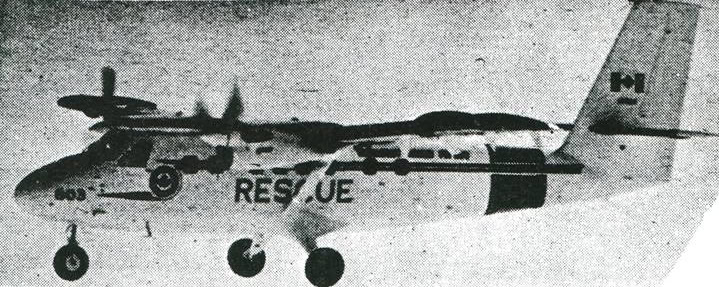
In July 1971, the first of another fleet of DeHavilland aircraft reached 424 Sqn. The Twin Otter, destined to take the place of the venerable Dakota, began service, not only in a search and rescue role, but also as a member of the United Nations Truce Team in Kashmir.
Their arrival followed the departure of six Caribou for Tanzania. In moving ceremonies, 424 Sqn bid good-bye to the aircraft which had served the RCAF and CAF for 10 years.
The change of aircraft marks a new era for 424 Sqn. With two new, Canadian built, aircraft the Tigers will continue to carry out their light transport and search and rescue operation as part of Air Transport Command.