

“On Wings of Fire”
The Story of 426 (Thunderbird) Squadron
(Republished from the 2 September 1971 issue of Contact)

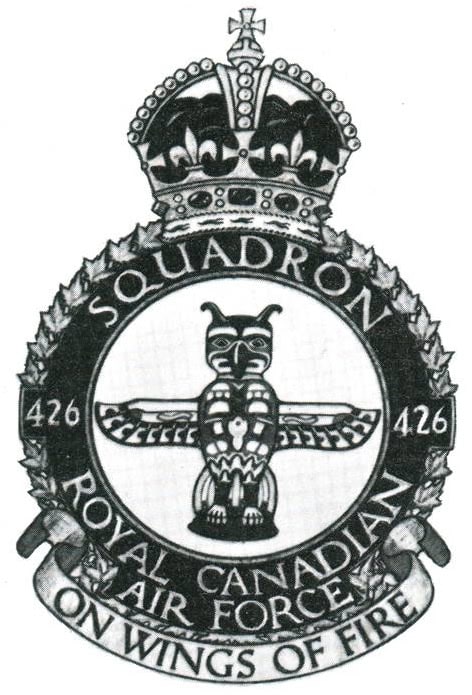
The story of No. 426 (Thunderbird) Squadron of the Royal Canadian Air Force began on 15 October 1942 when it was formed at Dishforth, Yorkshire, as the seventh Canadian Bomber squadron overseas. It commenced operations with No. 6 (RCAF) Group of Bomber Command on 14 January 1943 and for 28 months the Thunderbird Wellingtons, Lancasters and Halifaxes played their part in crushing the defences of Hitler’s European fortress. When the war in Europe ended the squadron assumed a new role as a transport unit, flying Liberators on the “trooping run” from Britain to India.
Disbanded in the United Kingdom on 31 December 1945, No. 426 was reformed at Dartmouth, Nova Scotia, on 1 August 1946 as a unit in No. 9 (Transport) Group of the RCAF. In the Succeeding sixteen years its Dakotas and North Stars have transported men and supplies throughout Canada and the world. With the introduction of turbo-prop strategic transport, the Yukon, the North Stars were finally put out of service and the Squadron officially disbanded on 9 September 1962. The Squadron was re-activated on 3 May 1971 as an amalgam of 4 Field Technical and 4 (Transport) Operational Training Units.
When the Thunderbirds began operations in January 1943, Bomber Command was assisting in the Battle of the Atlantic by pounding at the bases from which the U-boats operated. No 426’s first target was Lorient, an important Base on the Bay of Biscay; eight times within a period of 5 weeks the squadron’s Wellingtons struck at the U-boat pens in the port. Then the weigh of attack shifted to targets in Germany and the bomber crews got their first taste of the flak defence guarding Happy Valley (the Ruhr). In addition to Duisburg, Essen, Buchan, other munitions centers in the Valley, the squadron also bombed Nazi Ports and industrial cities in the Rhineland. Interspersed with the bombing raids were numerous mine-laying operations to disrupt German sea-bourne traffic through the Frisian Island waterways and to other focal points such as Brest, Heligoland, Keil and Karmony (in Norway).
W/C S.S. Blanchard, the Thunderbirds’ first CO, was lost in a raid on Cologne in February 1943. He was succeeded by W/C L. Crooks, DFC (AF), who won the DSO two months later on a sortie to Duisburg.
Operations on Wellingtons continued until June when conversion to Lancasters began, and at the same time No. 426 moved to Linton-on-Ouse, where it remained until the end of the campaign in Europe. In five months on Wimpies the Squadron made 447 sorties on 36 bombing and 18 mining operations; 20 aircraft were lost (11 of them over the Ruhr), with personnel casualties of 94 killed or presumed dead and 10 prisoners or “safe”.


After a period of training on the new 4-engine heavy bombers the Thunderbirds returned to the Battle on 17 August 1943. The target was Peenemunde, the Nazi rocket and Jet experimental station station on the Baltic coast, and Bomber Command’s assault that night dealt a serious blow to the enemy’s projected V-1 campaign against Britain. But No. 426 Squadron lost two of it’s nine crews, including one led by W/C Crooks, Command of the Thunderbirds passed to W/C W.H Swetman, DFC who had already completed one tour with No. 405 (RCAF) Squadron.
The “Big City” (Berlin) came into the Thunderbirds’ bomb sights for the first time on 23 August, and in the next few weeks other new targets — Nuremburg, Munich, Hanover, Leipzig, etc., were added to the list. In November the squadron entered the Battle of Berlin which raged for the next three months. In that period No. 426’s Lancasters made 14 attacks on the Nazi capital sending out 174 bombers, of which 14 were lost.
As winter passed, preparations for the invasion of Normandy increased in tempo. In March 1944 Bomber Command began an offensive against the enemy’s lines of communication in Western Europe, and attacks on rail targets in France were interspersed with longer-range strategic blows at the Reich. In April and May tactical targets, such as junctions, freight yards, and rocket sites, predominated, as the aerial preparation for the assault reached its peak, In the midst of this busy period the squadron shifted from Lancasters to Halifaxes, making the change virtually without breaking stride. During the 9 1/2 months No. 426 operated on Lancasters, it made 605 sorties on 57 bombing raids and 1 mine-laying expedition; 32 aircraft were lost with 173 officers and airmen killed or presumed dead, and 41 prisoners of war or “safe”. W/C Swetman left the Thunderbirds at this time, on completion of his second tour, and was decorated with the DSO in tribute to “the fine fighting spirit’ he had instilled in his squadron. He was succeeded by W/C E.C. Hamber.
On the night before D-Day the Thunderbirds silenced a heavy coastal battery at Howlgate on the eastern flank of the invasion area. For the next four months they continued their attacks on tactical targets in support of the Allied forces in Normandy: bridges, rail junctions and yards, and many V-1 installations were bombed, as well as enemy defences around Caen, Le Havre, Boulogne and Calais. Allied air superiority over Europe made it possible for the bombers to operate in broad daylight with negligible losses. In August the offensive rose to a climax, unequaled in the history of 6 Group if not of the whole of Bomber Command. No. 426 made 258 sorties on 18 attacks (of which 11 were made by day); there were no losses.
W/C Hamber left the squadron early in July on completion of a most successful tour which won him the DFC. He was succeeded as commanding officer by W/C C.W. Burgess who likewise was decorated for his brilliant leadership of the Thunderbirds.
As summer waned and the tide of battle flowed eastward, there was less need for tactical support from the heavy bombers and the Command returned to the all-out strategic campaign against the crumbling economic structure of Hitler’s empire. Through the autumn and winter the Thunderbirds helped to complete the destruction of the Ruhr’s munitions centres and attacked many other targets, especially synthetic oil refineries upon which the German Army, Air Force and Navy depended for their life-blood. When W/C Burgess was screened early in January 1945, on the completion of his tour, W/C F.C. Carling-Kelly took over command of No. 426. His tenure was unfortunately very brief. In an attack on freight yards near Stuttgart, late in January, he was shot down by a night-fighter and captured with several of his crew. W/C C.M. Black replaced him in command and led the Thunderbirds until the end of the European Campaign.
Winter weather naturally caused a decrease in the scale of operations through November, December and January, but in February the pace quickened as Bomber Command again poured the full weight of its destruction upon the dimishing enemy targets. The Thunderbirds made 12 attacks upon oil refineries and industrial centres, chiefly in the Ruhr, and went out twice in close support of Army operations along the lower Rhine. In the last fortnight of the month the heavy bombers resumed daylight sorties over the Reich; only 12 of the last 31 raids carried out by No. 426 Squadron were made under cover of darkness.
In March the long bomber offensive rose to a peak. The Thunderbirds recorded over 1409 flying hours, a total unequal led in their career as a bomber unit, while the number of sorties (231) was exceeded only by that for August 1944. March’s operations were highlighted by the last blows at the ruins of the Ruhr (soon to be occupied by Allied forces), and by several attacks in preparation for and support of the airborne crossing of the Rhine at Wesel.
Targets were now becoming fewer as the American, British, Canadian and Russian forces drove ever deeper into the Reich. In April the squadron made only eight attacks, one of which was wholly abortive due to unfavourable weather. On the 18th the Thunderbirds shared in a very successful raid on Dunc, close by Heligoland, during which the island and its airfield were smothered under a torrent of explosives. A week later No. 426 made its last bombing attack in the war when coastal defences on Wangerooge Island were covered by a pall of dust and smoke.
Since converting to Halifaxes a year previously the squadron had made 149 bombing attacks for a total of 2161 sorties; 36 aircraft were lost, with 158 of the crews reported killed, presumed dead or missing, and 82 prisoners or safe. In all, between 14 January 1943 and 25 April 1945, the squadron sent out 3233 aircraft on 242 bomb raids, 19 sea-mining operations and 7 sea searches. Losses totaled 88 aircraft, including 70 missing over enemy territory and 18 crashed in England. In personnel the Thunderbirds lost on operations 425 killed, presumed dead or missing, and 133 prisoners or safe; non-operational losses totaled 4 officers and airmen killed or died. The squadron won over 176 decorations and honours.
Late in May, when most of the squadrons in 6 Group were flying back to Canada to prepare for operations in the Pacific theatre, No. 426 was transferred to Transport Command and moved to Driffield for a short time before going to Tempsford in Bedfordshire. W/C Black, who had been awarded the DFC for his fine example of leadership and courage, returned to Canada with many of the bomber crews, and new personnel were posted in to build up the new transport squadron. Liberators replaced the Halifaxes and on 30 September the Thunderbirds, now under the command of W/C DR. Miller, AFC, began “trooping to India”. From bases in the United Kingdom and Belgium troops were picked up and flown to Egypt and India, on the return trip repatriated soldiers were flown home.
In three months on this work the squadron made 120 round trips, carrying over 5500 passengers and flying 987,240 transport miles without injury to one passenger or accident more serious than a collapsed nose-wheel. This brilliant achievement, unequaled in Transport Command, won the Canadian air and ground crews congratulations from the Air Officer Commanding in Chief of the Command. On 31 December 1945 No. 426 Squadron was disbanded at Tempsford.

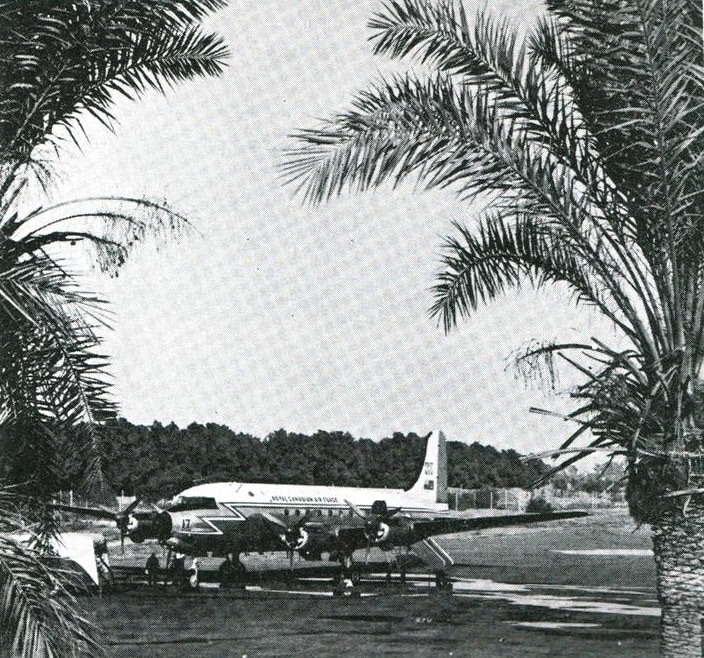
Seven months later the squadron was reformed at Dartmouth NS., under W/C C.A. Willis, DFC, as one of the units in No. 9 (T) Group (presently Air Transport Command) of the RCAF. Equipped with, Dakotas, No. 426 became the supplier of Goose Bay. On 15 March 1947 the advance party commenced re-organization at Dorval Airport, Montreal. Domestic accommodation to support the Squadron was acquired in nearby Lachine. On the same day W/C C.G.W. Chapman DSO, succeeded W/C Willis as Commanding Officer. On 22 March the last “milk-run” to Goose Bay from Dartmouth departed. Two days later operations began from Dorval Airport. Still equipped with the venerable
Dakota, the squadron was anxiously awaiting delivery of a “modern” global transport. The first North Star arrived from Canadair on 12 September and training commenced in early November 1947.
A new chapter in the annals of the Thunderbirds was about to be written with the introduction of the “North Star”. In February 1949 W/C C.H. Mussells, DSO, DFC, succeeded W/C Chapman who was posted to RAF Staff College. Following Prime Minister St. Laurent’s statement on 19 July 1950, the Chief of the Air Staff issued on 20 July, a directive to take immediate action to integrate the operations of the “Thunderbird Squadron” with those of the U.S. Military Air Transport Service for airlifiting personnel and material from the United States to Japan.
In the late afternoon of 25 July 1950, six North Star aircraft left Dorval enroute to McChord Air Force Base, Tacoma Washington, where they arrived the following day. On 27 July, thirty-six hours after arriving at McChord, the first three aircraft departed for Haneda Airport, Tokyo. The round-trip distance of about 10,000 miles was flown within an elapsed time of 80 hours of which 50 hours comprised actual flight duration. An average of 34 fully-equipped troops were carried per flight. Initially the squadron used six North Stars, the number was eventually increased to full establishment of twelve. At peak Operation the unit was making approximately one trip per day. Most of the flights were over the northern route via Alaska and the Aleutions. A southern route via San Francisco and Hawaii was used to a much lesser extent due to greater leg distance.
The records set by the Thunderbirds greatly impressed their USAF cohorts who flew the C-54 Transports.
At the end of the first year of operations (27 July 1951) the squadron had flown almost 250 round trips, 2,750,000 miles, over 6,600 personnel and 1,700,000 pounds of freight and mail.
On 1 June 1951 W/C Musselis, who had been in command of No. 426 since the beginning of the airlift, became Senior Personnel Staff Officer at Air Transport Command Headquarters, Lachine, PQ. His successor was a young Nova Scotian bomber pilot, W/C J.K.F. MacDonald. it was during his tenure that the Thunderbirds’ transport image of hard work reached its zenith. On behalf of the Canadians he was presented with the United Nations pennant by the MATS commander. The Thunderbirds’ achievements; aircrew, groundcrew and their North Star aircraft became legendary throughout Military Air Transport Service. Ground crews were working twelve to fourteen hour shifts, aircrews flying one hundred and fifty hours per month, and the monthly flying rate had been notched up to 1800 hours for the squadron.
On 23 June 1951, No. 426 Squadron was relocated at Dorval. This shift was done for two reasons. The expansion program of the USAF at McChord required more space, and it was decided that with the critical supply period in Korea over, 426 could better handle its other duties, additional to its airlift tasks, if based once again at Dorval. The movement back to its base was made without disruption of its airlift commitments, and since then, in addition to fly the airlift at the reduced rate of 15 trips per month, the squadron was air supplying northern Canadian bases as well as newly established RCAF Fighter Wing in the United Kingdom.
In June 1952, shortly before the squadron’s second anniversary of the beginning of the airlift, W/C H.W. Lupton of Regina took over as CO, being the third CO to head the Thunderbirds since it began the Korean Airlift. W/C MacDonald took over duties with the RCAF Air Division as it moved to the Continent from the United Kingdom.
The history of the Thunderbirds becomes quite inexact during the next six years, as all squadron records including aircraft logs and an aircraft were destroyed when a hangar burnt down at Lachine. However, No. 426 was involved in “‘trooping”’ the Indo-China Truce Commission to Saigon between August 1954 to October 1955. The airlift in the commencement of operations first circled the globe. Later a route from Montreal to Saigon via Gander, Lajes, Gibralter, Malta, Cyprus, Iraq, Karachi and Calcutta was used to carry the truce teams. On the average, each North Star carried twenty-five to twenty-seven members and their baggage for their year’s work on the commission. In 1956, in reply for United Nations Emergency Force action, 426 Squadron was used to take Canadian Troops and supplies to the Gaza Strip. September 1959 saw the squadron moved to Trenton due to the deactivation of RCAF Station Lachine. Throughout 1961 the squadron, along with the two 119 squadrons, was heavily committed to strategic airlift in support of United Nations action in the Belgian Congo. Throughout the UNEF actions the Thunderbirds maintained three flights per week to Marville, France in support of 1 Air Division as well as the resupply to the Joint Arctic Weather Stations.
426 Squadron moved from RCAF Station Trenton to St. Hubert under the command of W/C A.J. Mackie during January 1962. The Thunderbird Squadron was disbanded on 9 September 1962. On 19 October 1962, the last North Star, No. 17511, was flown away by 129 Acceptance and Ferry Flight for disposal.
Today the squadron is officially known as 426 (Transport) Training Squadron. It is responsible for training both ground-crew and aircrew for Air Transport Command. ironically, in direct opposition to the squadron motto “ON WINGS OF FIRE”, No. 426 is completely wingless, without even a Piper cub on its inventory. The new squadron, an amalgam of the former 4 Field Technical Training, and 4 Operational Training Units held its squadron re-inauguration and change of command ceremonies in July 1971, as LCol D. Kuhn, a former Thunderbird Squadron member, succeeded LCol F.M. Murphy, now Base Operations Officer at CFB Trenton.