

The Memorial Gates
(Republished from the 2 September 1971 issue of Contact.)

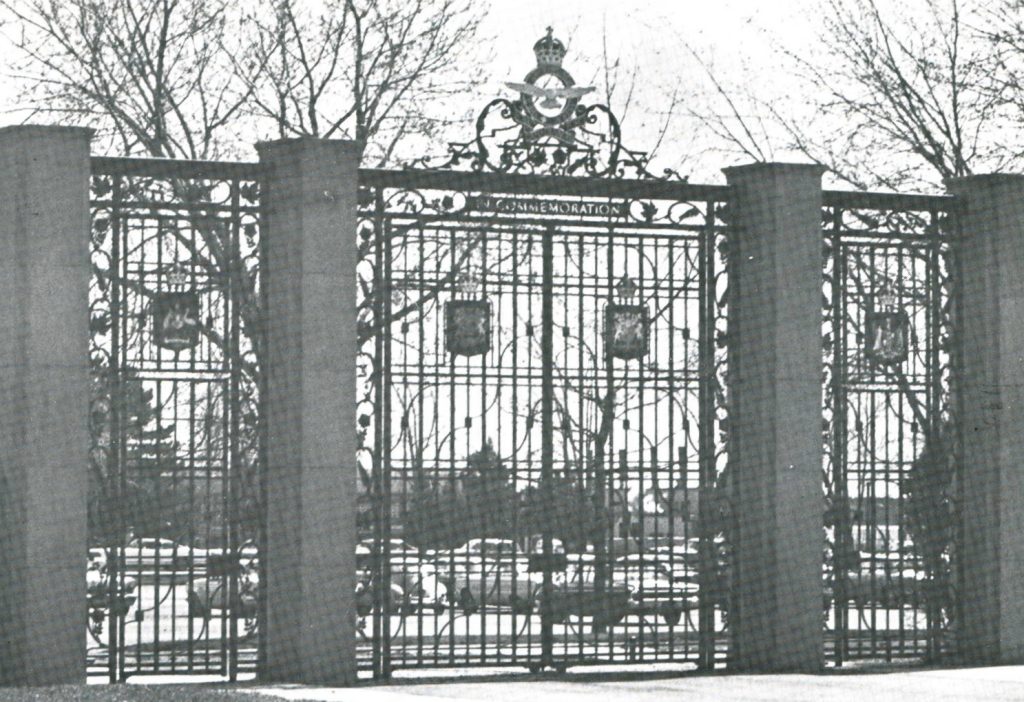
The British Commonwealth Air Training Plan brought many things to many people, and one of Trenton’s lasting results can be seen today on the main parade square. The handsome, wrought-iron gates, topped by the badge of the Royal Canadian Air Force, commemorate our part in that massive World War II training plan.
Between October 1940 and March 1945, over 131,000 British subjects were trained as aircrew in Canada, many of them at RCAF Station Trenton. These men had come from Canada, Britain, New Zealand and Australia and when the batlle had been won, the other three countries sought to honor the effort made by Canada.
Initially, the plan was for the three countries to provide a memorial avenue of mixed Australian, British and New Zealand trees at Camp Borden. It was soon realized, however , that no trees indigenous to Australia and New Zealand could withstand the Canadian Winter. The proposal was reframed as an avenue of English oaks with pavilions of native timbers from other Dominions. At this point, the Department of Agriculture advised that Camp Borden too exposed for such a venture, and suggested Trenton as an alternate. The third plan included a row of oak trees on either side of the Highway,and the imposing gates in lieu of the two pavilions.
The first of the trees were planted in April, 1945, by Miss Virginia Bell-Irving who was the daughter of the Commanding Officer. In all, 130 trees line the highway, and these are all the best of English oaks from the Dayham Abbey Estate, of the Marquis Camden, near Tunbridge Wells.
The gates are of wrought-iron, set in concrete and bear a border of leaves representative of the four countries. On each of the four portals is the coat of arms of one country, and, above all, stands the RCAF badge. On each side in English and French is the inscription:
“These gates have been given to the Royal Canadian Air Force by the governments of the United Kingdom, Australia and New Zealand to commemorate their partnership with Canada in the British Commonwealth Air Training Plan and the service of the airmen who helped bring victory to the allied cause in the Second World War.”
1939 – 1945
The gates, first opened on September 30, 1949, when the gates were presented to Canada by representatives of Britain, Australia and New Zealand. They are now kept closed, except for ceremonial occasions and remain a prominent tribute to the men of the RCAF, who made possible the British Commonwealth Air Training Plan.