
(Republished from the 20 October 1993 issue of The Voxair)
By Lt(N) Dave Scanlon
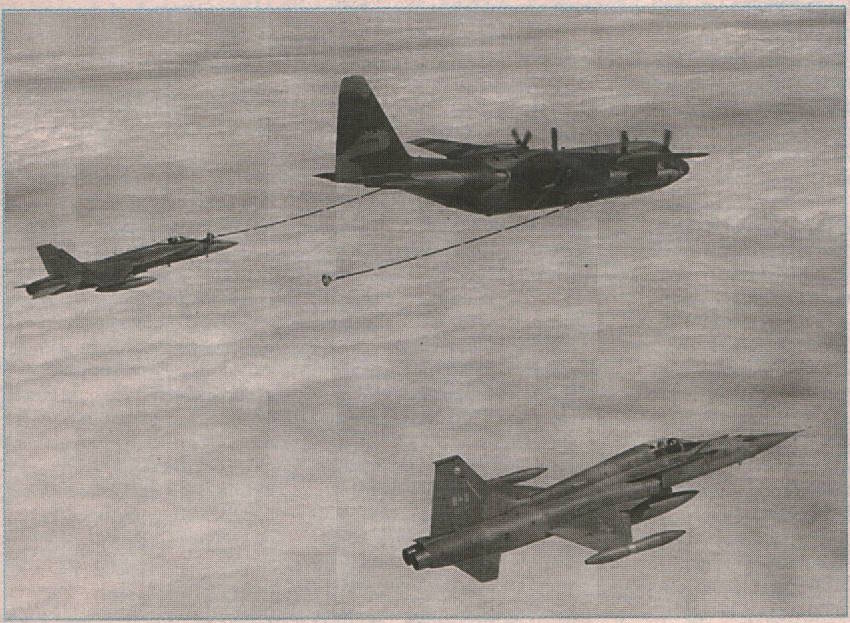
After two years of research and modifications, Canada’s new tactical refuelling and airlift aircraft, five CC-130T Hercules, are operational. After being brought into service late in the Gulf War for tactical airlift, the Hercs were sent back to be refitted with an air-to-air refuelling system, marking the first time in recent history a standard Hercules has been converted into a tanker after purchase.
In 1986, the Canadian Forces had identified a need for a tactical refueller and were looking at buying several Hercules tankers, known as KC-130s, from Lockheed Aeronautical Systems Company in the United States. However, by the summer of 1990, with the Gulf War and a host of UN peacekeeping operations looming on the horizon, the CF was faced with an urgent need to boost its tactical airlift capability.
The solution was to kill two birds with one stone. Lockheed was able to meet the CF’s immediate need for five C-130 Hercules aircraft to handle tactical airlifts (three were delivered in time to see service in the Gulf War); and, in response to a proposal from the CF, Lockheed agreed to refit the five Hercs within two years with air-to-air refuelling systems.
Using the Hercules’ existing “plumbing,” Lockheed’s Edmonton based sub-contractor, North West Industries (NW), installed a removable refuelling pod under each wing — each pod contains a retractable hose connected to the aircraft’s fuel system. The pods are made in Britain by Flight Refuelling Limited (FRL) and are the same as those used on the Royal Australian Air Force’s Boeing 707 tankers.
The cargo space of each aircraft was modified to receive a removable 15,000 litre fuel tank with in-built high-speed pumps, all of which connects to the aircraft’s fuel system. In addition, to help other aircraft find the tankers, the CF installed an air-to-air tactical navigation (TACAN) system — in effect a beacon for aircraft with TACAN receivers.
The tanker has two configurations: pods and fuel tank, for refuelling missions; and no pods or fuel tank (or, to save time, pods only), for tactical airlift, search and rescue, or other uses. Air Command will likely keep two of the tankers configured full-time for refuelling and the remaining three configured as needed.
After a few wrinkles were ironed out, the CF conditionally accepted the first modified Hercules in June 1992. Lockheed trained the first crews last year at CFB Cold Lake, Alta., and CFB Bagotville, Que. The CF took over training in late 1992 and the first official CC-130T air-to-air course was completed in January.
All five tankers were accepted into service by June and are now based at 18 Wing (Edmonton), where they are operated by both 435 Squadron, which conducts air-to-air refuelling and tactical airlift, and 418 Reserve Squadron, for search and rescue.
The new tankers could conceivably play an additional role for the CF as strategic, or long-range air-to-air refuellers. With the CF’s fleet of CC-137 Boeing 707s close to retirement (likely by 1996), there is a need for a new strategic tanker.
Although the CC-130Ts could not be used as true strategic tankers due to their limited range, flying speed, and fuel capacity, they could act as prepositioned refuelling stations. The other option under consideration is to install refuelling systems in the CF’s five new strategic airlift aircraft, the CC-150 Polaris (known commercially as the A-310 Airbus).
In any event, the Hercules, in all its configurations, continues to be the “work horse” aircraft of Canada’s Armed Forces.