
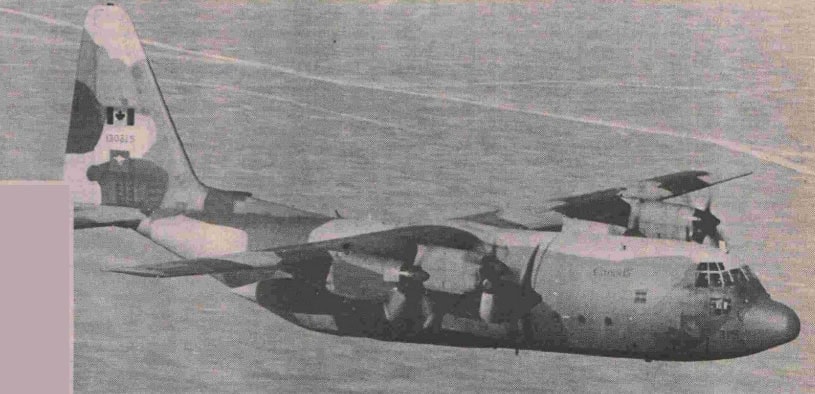
Hercs sets world service record
(Republished from the 23 April 1997 issue of the Voxair)
Taken from the 02 April 1997 edition of “Contact – A Military Community Newspaper, 8 Wing/CFB Trenton”
8 Wing, CFB Trenton – Earlier this month CC130315, a Canadian Forces Hercules aircraft, based at the Canadian Air Force’s 8 Wing Trenton surpassed 40,000 flying hours, a world record for C-130 Hercules in military operations.
Taken into service at Edmonton in 1965, 315 has flown in UN operations in over 59 countries, and worked as part of an ALCE in 26 countries.
On Air Force Day, April 1,8 Air Maintenance Squadron (8 AMS) hosted a reception for those affiliated with Hercules aircraft. In addition to the men and women from 8 Wing who fly and maintain the Hercules, representatives attended from the manufacturer, Lockheed of Georgia, USA — and from the maintenance organizations, CAE of Edmonton and Standard Aero of Winnipeg.
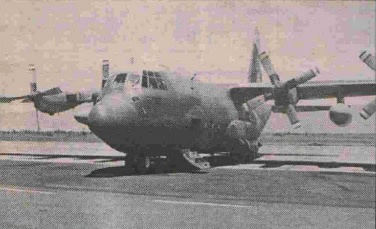
Images provided by AMCRO Log Control (435 Sqn) and Wing Imaging, Trenton 8 AMS.
HISTORY
HERCULES CC130 315
Aircraft 315 was purchased in May 1965 by the RCAF as part of a 20 aircraft purchase from Lockheed Aircraft in Marietta, Georgia. The E-model aircraft replaced the existing fleet of B-models, having proven themselves to be an exceptional air transport aircraft. Originally delivered to 436 Sqn in CFB Ottawa, 315 was transferred to CFB Edmonton in 1969 as part of 435 Sqn. In 1973, 315 was transferred to its present location at 8 Wing Trenton.
Over it’s lifetime, 315 has been flown and operated in a number of roles – air transport of freight and pax, troop transport, paratroop airlift, LAPES, SAR and humanitarian airlift, to name a few. It has been flown into over 50 countries around the world, has been part of ALCE’s in dozens of countries and has participated in hundreds of operations over its 32 year career.
Of the original airframe delivered in 1965, many of aircraft 315’s components and parts have been repaired, overhauled and replaced. In 1986, it received a new set of improved H-model outer wings and in 1972, it had a new H-model centre wing installed. Of the original four engines, three are still in service on other airframes. The original ramp and landing gear assemblies are on other airframes as well – in fact, the majority of instruments and routable components have been overhauled and integrated into the rest of the fleet.
Aircraft 315 has undergone over 600 modifications during its life, most recently received a modern EW and countermeasures suite, as well as armour plating so as to increase survivability in a hostile environment. Aircraft 315 is slated to have an Avionics update, which will help standardize the CC130 fleets cockpits as well as meet the demands of the 20th century avionics environment. During aircraft 315 structural inspections, it was found that its structure had been maintained to a high standard and was representative of an aircraft that is at a midpoint of its achievable life.
This quality was achieved through 11 Progressive Structural Inspections, 48 Periodics, 84 Supp checks and 84,000 manhours of desnagging. The Hercules Support Team is comprised of a long list of both military and civilian agencies. To name but a few, they are as follows: Lockheed Martin Aeronautical Support (OEM) CAE Aviation Ltd. (3rd line overhaul of structure AUP, engineering support), Standard Aero (engine and propeller overhaul) DAEPM(TH) (WSN), 8 AMS (1st and 2nd line maintenance), 2 AMU (loading) 8 Wing Trenton (infrastructure and Logistic support), 413, 424, 426, 429, 435, 436 Squadrons (operations).
Aircraft 315 officially reached 40K flying hours over 8 Wing Trenton on 10 March 1997, at 1730 hours ZULU.