
Tee Emm
Service Training Memorandum
Published by the Air Ministry, London, UK
August 1941

United Kingdom Air Ministry
August 1941
Number 5
Source: The Collection of RCAF.info
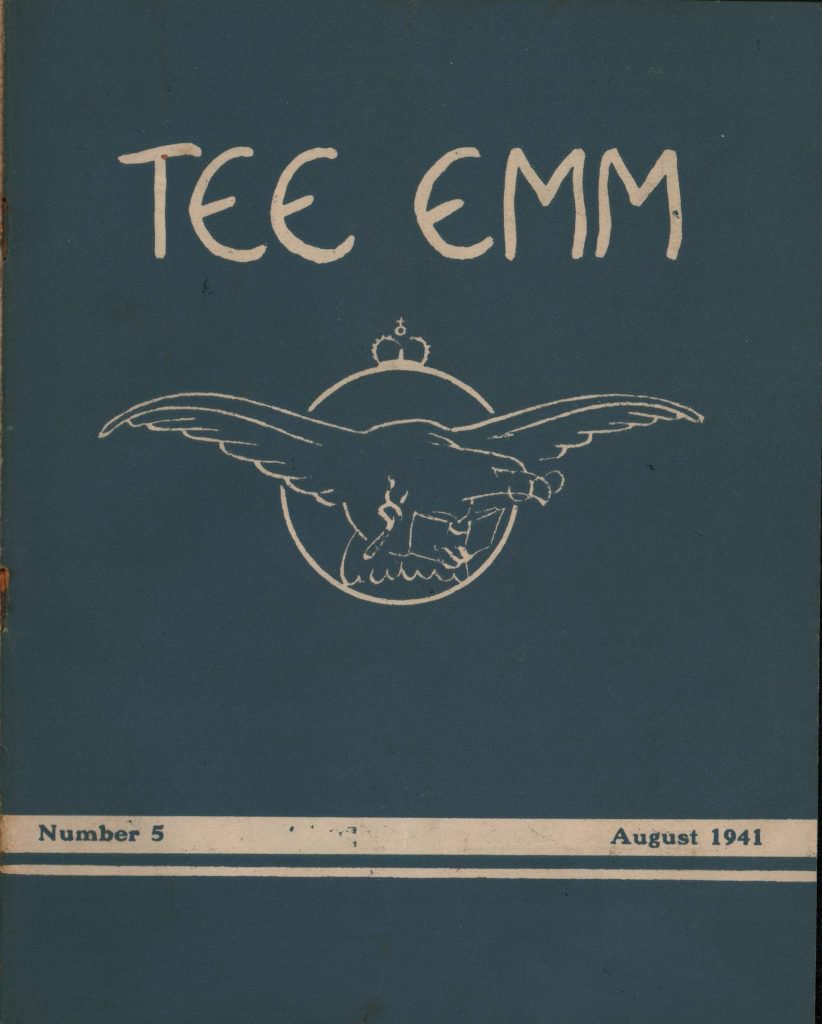
Source the Collection of RCAF.info
Love me… Love my Log
OUR Sergeant Straddle turned in a log the other day which read something like this :

- 1800 hours. – Airborne MILDEN-HALL. Set Course for Malta.
- 1820 hours. – Altered Course to intercept E/A
- 1821 hours. – Sorry, it wasn’t ! Altered Course to avoid collision with friendly aircraft.
- 0600 hours. – Landed MALTA.
Garrulous fellow, this Straddle, hey? Was the journey really so devoid of incident? Or perhaps he is saving up everything for his forthcoming autobiography ” ERK TO SERGEANT, or Six Weeks in the R.A.F .”?
Now it is obvious that the above log is not a genuine one. You would have laughed contemptuously, rather than just amusedly, at Sergeant Straddle, if it had been. But what about this—a perfectly genuine log turned in by a Navigator after a night operation? It contained no details of weather forecast either over the route generally or over any stages of the route. It had no items entered in the memorandum sections so as to aid memory; and the right-hand middle page had no entry on it as to either required true track, true course, or magnetic course. Beyond four entries as to change of course, it provided only the most general remarks opposite time entries, such as: “detour to clear cloud”; “target : height 4,000 feet”; “bombs dropped”; “coast”; (which coast was not stated) ; “beacons”; (no characteristics were given).
Now, frankly, keeping a log like that is wasting paper. Form 441, the Navigation Log, has four pages, each 8+ inches by II inches, and is meant to be used intelligently. As P.O. Prune says, “it’s there to be got full value out of.” (An ungrammatical fellow, Prune : we, of course, never use a preposition to end a sentence with!) This mans you must not only use the log to help you plan your flight, but you must also keep the thing going all the time you’re in the air, because in so doing you’ll force yourself (against the very common inclination to sit back and wait for things to happen) to keep on your navigational toes. Which is all to the good. In fact, you’ll find the hall-mark of a good navigator is a well-kept log, and though a bad Navigator can always cook up a good log afterwards, the log he keeps in the air is always bad. In addition a log provides a record of all a flight’s salient points, for you or for anyone else who wishes to consult it. For which last reason, in particular, it should:, be written up legibly and not in a fist somewhere between hieroglyphics, coptic, and a sketch map of a bit of trench system.
Here’s a good way to tackle it :—
Before you take off be sure and find out from your Captain what sort of a job you’re on. Make out the details along with the other navigators and check your figures and data with them. Make sure those blank spaces on the first two pages are filled in. Then make a date with the Met, and Intelligence Officers, and don’t forget the Signals Officer: he’ll have a lot of dope for you too. In short, do as much planning beforehand as you can. You’re only making difficulties for yourself if you leave it till you’re in the air, especially if your aircraft is one that doesn’t give you much elbow-room or a good view of ground and sky. There’s space on the second page for all sorts of odd gen: what stars you’ll have for your flight ; what special landmarks to look for; the time of rising and setting of the sun or moon; and so on. Painstaking planning has been chiefly responsible for the success of all the more difficult flights of this war.
Having got your log all ready to tell you what to look for when in the air, don’t forget to write down what you find out. For if you don’t write in your log, the damn thing will remain blank: that’s log logic ! Record all the important events of the flight—and that doesn’t mean waiting till somebody shoots your tail off. You can see from the plan how long you’ve got on each leg and what sort of things will be useful to you. And whenever you or the crew see something worth while, jot it down, along with the time. It may well come in useful to you or to someone else later on—especially if you use your imagination. This may all be a bit wearying at first, but if you do it neatly and conscientiously you’ll be thankful some day for having got into such a good habit.
When things are going smoothly, glance now and then at the log ; you’ll find it frequently prompts you to take a drift, or find a wind, or get a fix. It’s so easy to be woolly-headed during flight—more so than you perhaps will admit ; a look at the log will often stir your brain into activity.
For Navigation isn’t a cut and dried science which you can learn once and then know for ever. In practice you never quite know what’s going to happen ; your success as a Navigator depends entirely on your ability to collect and apply data with the help of your log. Useful inferences for the future can be drawn from what has happened in the past. Successful navigation, in fact, boils down to a good deal of checking and re-checking of plentiful and accurate observations in the log.
Lastly, when you get back from a flight the Ops. Room will want to hear all about it. Here the chap with a good log can give them the proper gen without trouble, and so an enjoyable time is had by all. Nothing is more irritating to the Ops. Staff or to later arrivals than a navigator searching through a badly-kept log for something important, and then finding it wasn’t recorded anyway ; while all the time the bacon and eggs are waiting in the mess.
Don’t forget that log-keeping is an effort, but it’s on that effort of yours that the success of every flight largely depends. Don’t be one of those people who like to keep their log so badly that it at last lands them awash in a rubber dinghy—though in that case at least, the others do get their bacon and eggs in time!