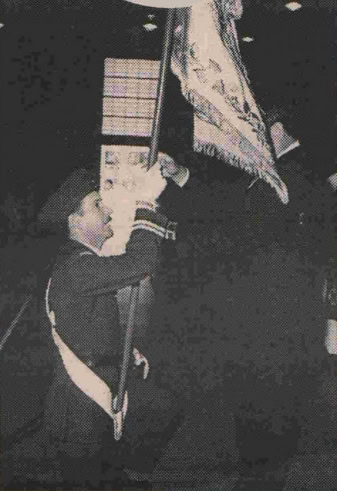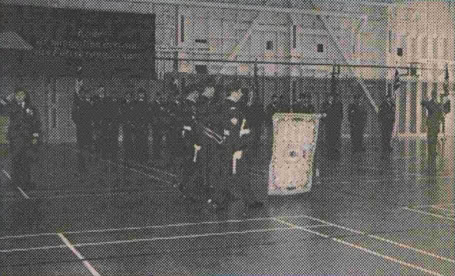
Squadron Standard
HISTORY OF ITS EVOLUTION
(Republished from the 15 October 1997, issue of the Voxair)
The history of the presentation and display of colours to identify military units stretches back many hundreds of years. In England, colours were used as a rallying point on the battlefield and as an inspiration to lead men into battle. Originally, every company had its own flag which was emblazoned with the coat of arms of the company commander. As armies increased in size, not all company commanders had a coat of arms and so it was ordered that all company flags should be of different colours to distinguish them and thus the flags became know generically as ‘colours’.
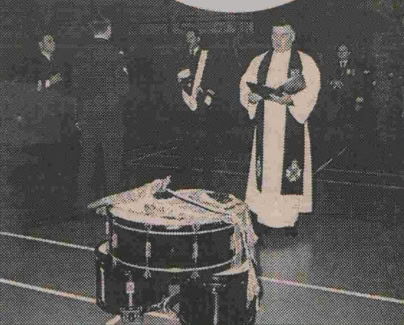
In 1943, it was decided that although Air Forces did not have the same historical reason to have colours, there was a need to recognize a squadron’s dedication and allegiance to the sovereign. Accordingly, the King approved the issue of standards (as air force colours are know) to RAF Squadrons. This privilege was extended-to the Royal Canadian Air Force in 1958, for squadrons which had 25 years of service or who have otherwise earned the “sovereign’s appreciation for especially outstanding operations”. In 1961 the first squadron standards were issued to three RCAF auxiliary squadrons, 400 “City of Toronto” Squadron, 424 “City of Hamilton” Squadron and 402 “City of Winnipeg” Squadron.
Two flags are usually displayed during parades, the sovereign’s colours, which in Canada consists of the Canadian flag with the sovereign’s crown and the squadron’s numerical designation in the center, and the squadron standard, which consists of the unit’s badge in the centre on a solid background with the squadron’s battle honours listed on each side.
The Squadron standard is an air force unit’s most prized possession, for it provides a link to the past and serves as a reminder of the sacrifices of those that went before. On presentation by the sovereign (or her designate), the standard is consecrated by the chaplain general (or his designate). Through this means the standard is sanctified and becomes a symbol of honour and duty; and all members of the squadron rededicate themselves to the maintenance of these qualities. Once consecrated, the squadron standard is closely guarded and when uncased, they are honoured by the appropriate compliment. Every effort must be made to prevent the capture of the standard by the enemy to the extent that it is destroyed on threat of capture by enemy forces.
402 “CITY OF WINNIPEG” SQUADRON

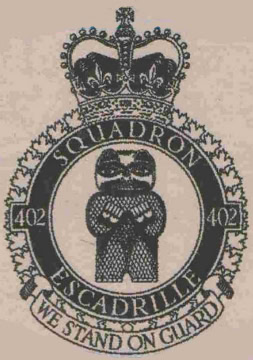
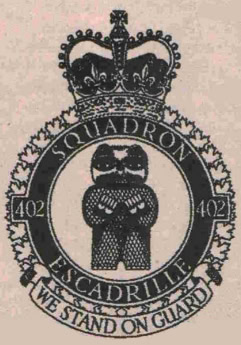
BADGE
Description: ‘Argent’ a standing grizzly bear totem of the North Pacific Coast Natives proper.
Significance: The grizzly bear holds a prominent place in Native mythology and is believed to have supernatural power.
MOTTO
WE STAND ON GUARD
BATTLE HONOURS
The Second World War
DEFENCE OF BRITAIN, 1941 – 1944
ENGLISH CHANNEL, AND NORTH SEA, 1941-1944
FORTRESS EUROPE, 1941-1944
Dieppe
FRANCE & GERMANY, 1944-1945
Normandy, 1944
Arnhem
Rhine


A brief history of
402 “City of Winnipeg” Sqn
By Lt J. Helps
With more than sixty-five years of service to its country, 402 “City of Winnipeg” Squadron is one of the oldest Canadian squadrons in existence. The Squadron’s purpose is reflected in its motto: “We stand on Guard”.

The Squadron was formed in Winnipeg in 1932 as one of the three non-permanent (Reserve) RCAF squadrons. At the outbreak of the war, in 1939, No. 112 Squadron (as 402 was then known), along with No. 2 and 110 Squadrons were chosen for active service and shipped overseas to England. Equipped with Hurricanes and, later, Spitfires, the re-named 402 (Fighter) Squadron completed many bomber escort, fighter sweep, shipping reconnaissance and ground attack missions for which it received eight battle honours. The Squadron made significant contributions to the Allied effort including air cover over the beaches of Dieppe and Normandy.
In the post war years, the Squadron has carried out light transport and search and rescue duties, participated in tactical training exercises, provided flying doctor services, taken part n air shows with the “Skyhawks” parachutists and brought the annual “Operation Santa Claus” to northern Manitoba communities. These activities have been conducted with a variety of aircraft including Harvards, Mustangs, Vampire and T-33 Jets, Expeditors, Otters and the venerable DC-3 Dakota.

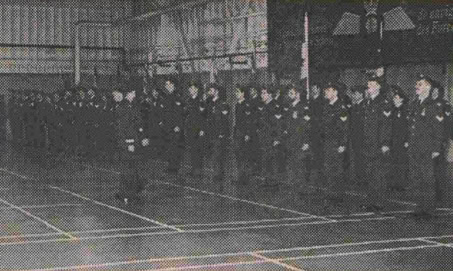
In 1990, in keeping with the recommendations of the defence white paper, 402 squadron was designated a “Total Force” squadron, which is made up of a mixture of both Regular and Reserve force personnel. Each plays a role in the maintenance, operation and training aspects of the recently acquired Dash 8 aircraft. Designated by the Canadian Forces as the CC/CT-142, this modern aircraft, with its advance avionics, is flown in support of the Canadian Forces Air Navigation School, and to provide light cargo and personnel airlift support.
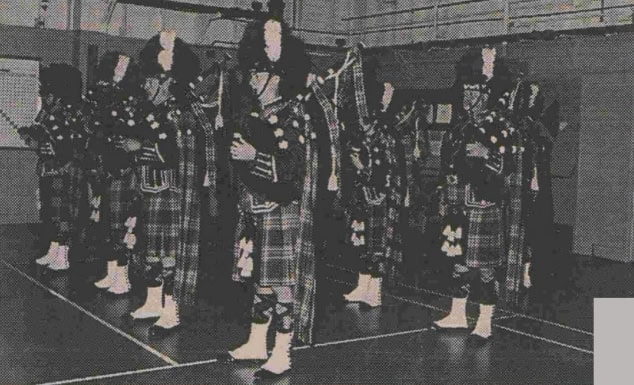
In constant demand at public, charity and military appearances, the Squadrons Pipes and Drums band has received international acclaim. Formed in 1954, the band has played throughout North America, Europe and England. In their fourth appearance, the band was honoured by being designated the 1994 featured band at the Scottish Highland Festival in Albuquerque, New Mexico.
Whether it be through the professionalism displayed when conducting flight operations, or by showing the flag at public relations appearances, squadron members take pride in demonstrating the concept of Total Force in action.