

(reprinted from the 10 February 1956 issue of The Voxair)

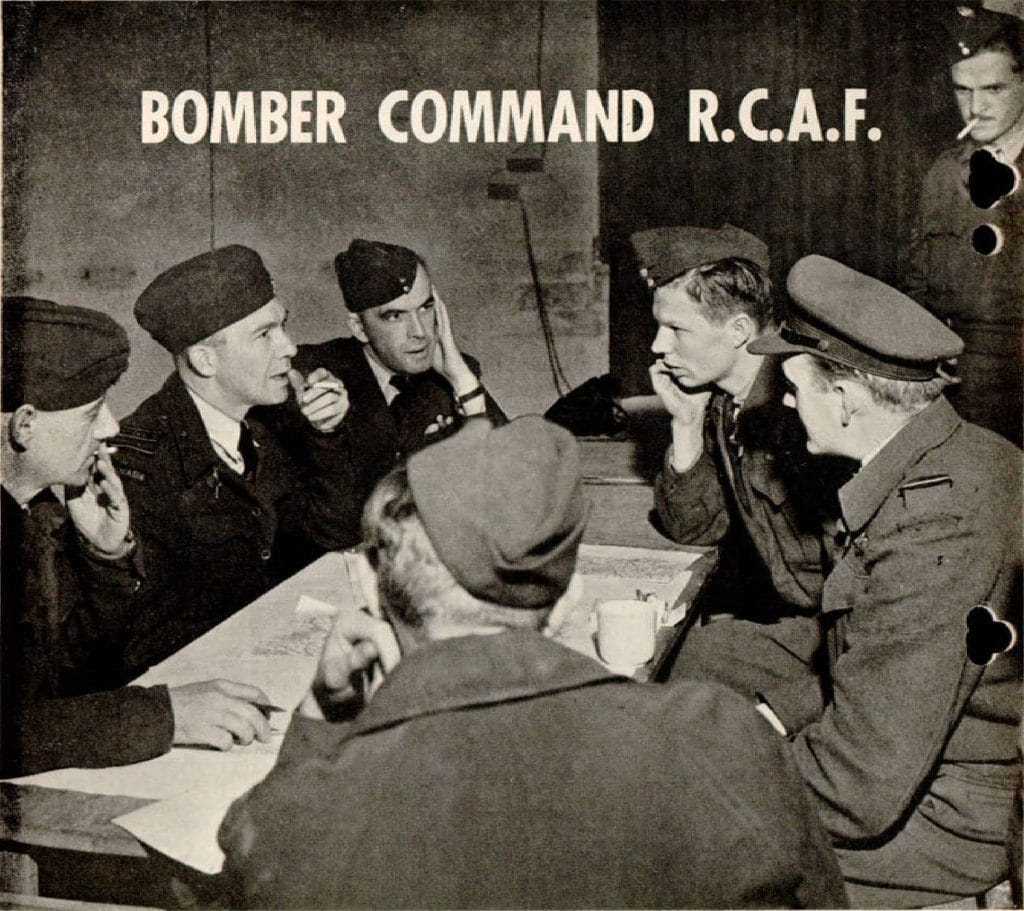
Part 1 of a three part story of an actual bombing operation over Dessau, Germany, carried out by Royal Canadian Air Force bomber crews during World War II
DURING the early years of World War II the work of Bomber Command was overshadowed by that of Fighter Command. The latter’s victory over the Luftwaffe in the Battle of Britain was followed by daylight bombing raids on enemy industrial targets. Then, since Luftwaffe had complete control continental skies, it became necessary to resort to attacks by night.
By 1942 new aircraft had been designed for the highly technical job of carrying the war at night to the enemy. The Halifax and Lancaster bombers were the work horses of the R.A.F. Bomber Command. By this time all-Canadian squadrons were also working with Bomber Command. The roar of heavily laden aircraft leaving the English countryside for “Happy Valley” and other points in the Reichland became a familiar and ever increasing sound. Navigation methods and navigation aids were improved by scientific research. Electronics and radio became involved in a war behind the scenes —new inventions by both German and British scientists were designed offset each other. Thus the tide of aerial warfare swept back and forth during the years 1941 to 1944.
To increase the accuracy of night bombing fleets a specialized Pathfinder force was developed in 1942. This force, made up of several R.A.F. squadrons and one Canadian squadron, developed a technique for locating targets and marking them with aerial and ground flares. The flares then became aiming points for the following bomber stream. As a result of this, bombing accuracy increased tremendously.
Before starting our story proper, let’s take a look at a typical Airforce Bomber Command Station situated “somewhere in England.”
Buildings in the average airforce station were kept as far apart as conveniently possible in order to minimize bomb damage from German hit-and-run raids. As a result the bicycle became the standard means of locomotion. Airforce personnel lived in wooden barracks or the ubiquitous Nissen hut with its round galvanized iron roof, cement floor and blackout curtains. These huts were grouped into communal sites and scattered around the perimeter of the aerodrome. Mess buildings, theatre, post office, gymnasium and chapel were also located in their respective communal sites.
An administration centre was usually located near the aerodrome control tower. There one found briefing rooms, clothing stores, aircrew lounge room, and parachute room. The hospital was usually found in some quiet corner of the station. Air raid shelters were scattered throughout the station and at all communal sites.
Aircraft were located at their own dispersal points around the perimeter of the aerodrome. Near each aircraft was a small canvas-covered shack to shelter the ground crew servicing their charge. Half a dozen ground crew men—fitters, (engine mechanics}, riggers (airframe mechanics) and instrument men were attached to each bomber aircraft. That particular “kite” became their “baby” and come hell or high water it was ready to fly when needed. If any engine were found to be unserviceable, even an hour or two before take off time, it could be torn down and reassembled. One could rest assured it was in as nearly perfect running condition as human hands could make it. Aircrew generally became quite attached to their own particular ground crew and spent many off-hours together. Such was the general layout of an R.C.A.F. Bomber Command Station.
The daily routine with no operations in sight started with personnel cycling to their respective messes to get breakfast, which often as not was sawdust-like sausage and well-watered powdered egg. Then on bicycle to the flight rooms with pilots reporting to their respective officers, bomb aimers to bombing leaders. If weather was unfit for flying, classroom lectures were in order. If weather was suitable for flying, and no operations signal had been received from bomber command headquarters then a flight training program was assigned each crew. For fighter affiliation a fighter aircraft made dummy attacks on the bomber, the latter taking evasive action. The fighter pilot reported on the bomber pilot’s ability in eluding him. In gunnery practice —generally carried out over the North Sea — the gunners would fire at a smoke float dropped on the water. Occasionally an air drogue was used as a target. Bombing practice usually consisted of small smoke bombs dropped on a ground target, the results being assessed by two observers stationed on the ground. Blind bombing practice consisted of a timed run from a navigation “fix” to a specific town. And, of course, there were cross-country trips, practice navigation flights of an hour or two duration to keep the navigator on his toes.
After 2 to 3 hours’ training the air crew returned to base and a meal of brussels sprouts, cold mutton stew, tea and vitamin pills. Afternoon duties were usually quite light. Checking aircraft equipment, skeet shooting for gunners to keep their reflexes sharpened up, dinghy drill, a drill carried out by the whole crew in their aircraft while parked at the dispersal point.
In the way of recreation, the station movie was always popular, with officers at the rear, in raised seats. The seating was slightly different on occasion, as for instance a moral-lifting leg show. Then the officers sat in front. Mess entertainment was varied—darts, dominoes, shove-ha’-penny, and the popular “mild and bitter.” A “Line Book” was always handy. Any mess member caught shooting a “line” had the story entered in the line book and paid the usual penalty, a round for each man in the mess.
When Bomber Command planned a night operation a signal was sent to all squadrons concerned by the previous noon. That signal gave all details of the raid as planned including the number of aircraft required from each squadron. The squadron commander picked out the crews required and a list of the pilots’ names with time of briefing was posted in all the messes and flight rooms. Crews were anxious that they should not miss an “op.” The average tour of operations required about 35 trips and everyone seemed to be in a hurry to find out how his luck would hold out.
OPERATION TO DESSAU, GERMANY
The signal from Bomber Command has come through and pilots’ names posted. Operational crews spend their spare time checking their aircraft and then sleeping, as no one knows as vet where the“ op” is, or how long the trip may take. An hour before briefing the crews have an “ops meal” of bacon and eggs, toast and coffee—a meal that is obviously enjoyed despite the implications.


As briefing time approaches the crews gather at the briefing room dressed in their flight boots, heavy sweaters and battle dress. Personal belongings are left in tagged bags with the intelligence section. Escape aids and candy rations are picked up and distributed to crew members. Escape aids consist of two plastic cases about 5” x 6″ x 1” made to fit into battle dress pockets. These cases contain equipment that would be useful if one is shot down over enemy territory and attempting to leave the country on foot. They contain small compasses, oil silk maps of Europe, knife, razor, fishing equipment, medical supplies, water purification tablets, language sheets, and two weeks’ concentrated rations.
For briefing the crews are seated at long tables, one crew per table, windows are blacked cut and doors locked. The briefing officer, generally the squadron commander, announces the target for the night — DESSAU. It is pin-pointed on a large wall map at the front of the room and a red ribbon marks the route to and from the target. After the “ohs and ahs” have subsided, the C.O. gives an account of the operation as planned. First, the reason for attacking this particular point — Dessau contains large marshalling yards and is a key communications centre. Second, the number of aircraft and types — 400 heavy bombers, about half of which will be Lancasters. Third, fighter cover, if any — at night a few squadrons of night fighters will operate with the bombers. These are usually Mosquito twin – engined aircraft. Their main function is to harass the enemy night fighters at their own bases in Germany—they give no actual support to bombers in the bomber stream.


The type of raid to be carried out is then discussed. There are several possible types which may be used.
NEWHAVEN — used when the target will be free of cloud cover. The Pathfinder aircraft, of which there may be two or three dozen, drop flares by parachute on the target area. These illuminate the country and the aiming point. The aiming point is then marked by red or green flares which burst a couple of thousand feet above the ground and cascade down onto the ground burning there for three or four minutes. The master bomber and his deputy, flying above the target, direct the bomber crews by radio, calling for bombs directly on the ground flares or perhaps a slight overshoot or undershoot depending upon the relation between ground flares (called TI’s for target indicators) and the aiming point.
WANGANUI — used when the target will be cloud covered. Pathfinder aircraft locate the target by dead reckoning or radar and drop flares which hang on parachutes at altitudes varying up to 15,000 feet depending on the height of the cloud cover. The master bomber then directs bomber crews to drop bombs on these sky fares. The flares are so placed that bombs dropped on them will continue down to the aiming point below the cloud cover.
OZOE — on short operational trips a target might be marked by flares dropped from Mosquito aircraft with a special remote control type of navigation whereby the pilot is instructed by radio from England when to drop his flares. Bomber crews then use these flares as aiming points.
The tactics to be used during the trip are discussed. On this particular trip to Dessau the crews will stay at low altitudes below 2,000 feet until they reach a point well inside France before climbing to their operating height. On certain legs of the trip altitude will be varied in order to keep the enemy confused. By staving below 2,000 feet German radar will not be able to pick up the bomber stream until within short range. The German radar screen covered all approaches from the west.
After the C.O. has given a general brief of the operation to Dessau, further briefings are given by the officers in charge of particular sections.

