

Canada’s Pioneer Air Mail
(Reprinted from the June 1959 issue of “Roundel”)

BY WING COMMANDER F. H. HITCHINS, Air Historian
(For the photographs which accompany this article we are indebted to Mrs. Brian Peck of Metis Beach, Que.)
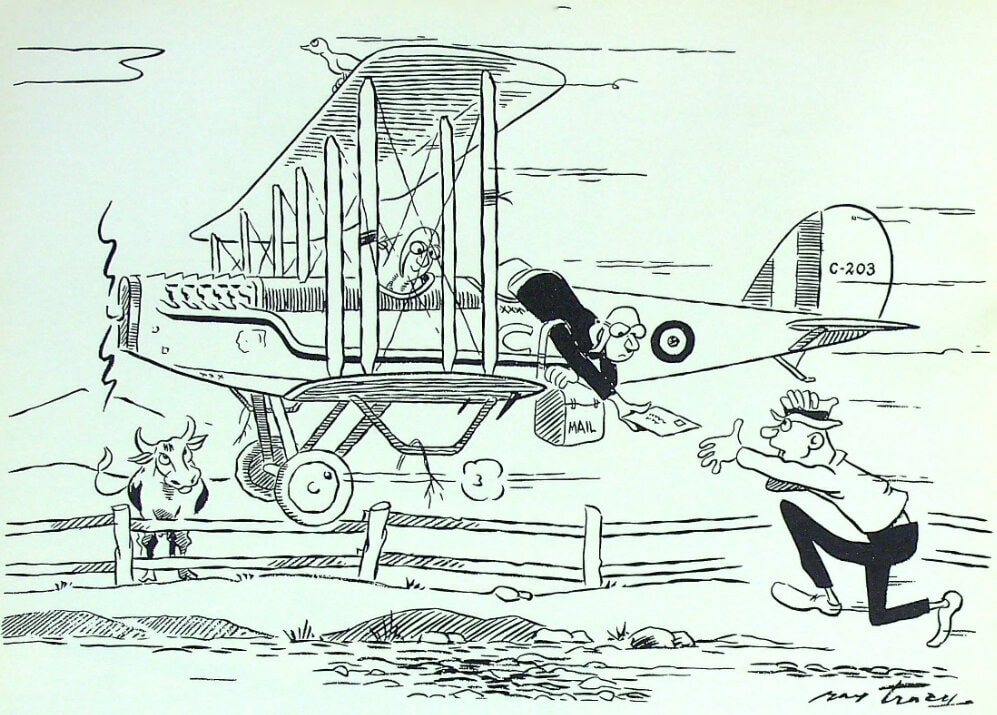
At 4.55 on the afternoon of Monday, 24 June 1918, a Curtiss JN4 biplane landed on the Royal Air Force aerodrome at Leaside, north-east of Toronto. To the casual observer there was nothing unusual about the arrival of the aircraft; it was just another in the dawn-to-dusk round of “circuits and bumps”. Nevertheless the “Jenny” had just made history, for nestled at the feet of the mechanic in the rear cockpit was a brand-new mail bag containing about 150 letters bearing a special cachet that marked them as Canada’s first officially sanctioned air mail.
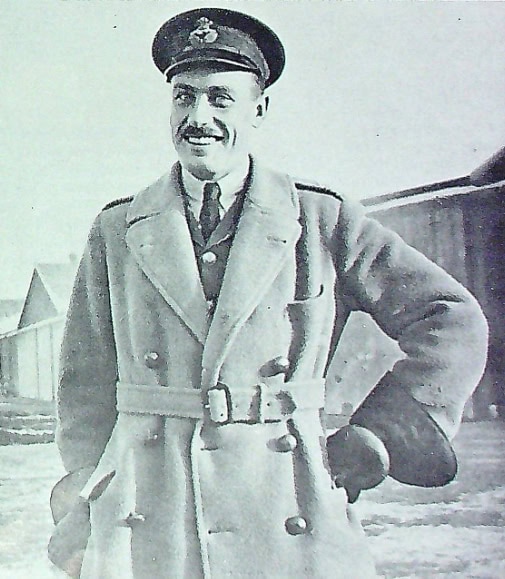
Although no fanfare of trumpets heralded his landing, Capt. Brian A. Peck, the pilot of the aircraft, had won for himself a place in Canada’s aviation hall of fame as the Dominion’s first air mail pilot.
A native of Montreal and a graduate of Lower Canada College and McGill University, Brian Peck enlisted in the artillery on the out-break of war in 1914 and, after almost two years’ service with a field battery, transferred to the Royal Flying Corps in March 1916. On completion of training as a pilot, he joined an army co-operation squadron in France with which he flew B.E.2Cs and R.E.7s over the battle-front for several months.
Posted back to Canada early in 1917, Capt. Peck was placed in charge of the Cadet Wing at Toronto when the R.F.C. began to organize its training establishment in central Ontario. His work with the Wing, and in particular the energy and skill which he displayed in setting up a School of Military Aeronautics before the trained staff arrived from England, received high commendation from the R.F.C. commander in Canada. Returning to flying duties, Peck subsequently commanded training squadrons at Long Branch and North Toronto and spent the winter of 1917-18 with the R.F.C. at Fort Worth, Texas. When the R.F.C. units returned to Canada in the early spring of 1918, Capt. Peck’s No. 83 Canadian Training Squadron was assigned to Camp Leaside to give artillery co-operation training to fledgling pilots.

MONTREAL IDEA
Although the first Canadian air mail was delivered at Leaside it was conceived at Montreal in the minds of some officials of the local branch of the Aerial League of the British Empire. For several years during the war the League had been active in stimulating interest in aviation and in raising money for the donation of aircraft to the Royal Flying Corps. As a further step to encourage aviation the officers of the League, led by Mr. E. Greenwood, the treasurer of the Montreal branch, in June 1918 arranged with the officials of the Montreal Polo Club to convert their grounds into an airfield. The polo grounds, on the Bois Franc road at Back River, had been abandoned as a sports field since the outbreak of war, but had been used on occasion by visiting aircraft. In announcing their proposal to develop the area as an airfield, the League suggested that it might be used for an air mail service.
The Royal Air Force at Toronto was informed of the League’s plans for the polo grounds and lost no time in taking advantage of the opportunity to use the field. The very next day Capt. Peck arranged to fly home to Montreal for the weekend and that afternoon (Thursday, 20 June 1918) accompanied by his mechanic, Cpl. E. W. Mathers, he took off from Leaside on Curtiss C-203. They broke their journey at Camp Rathbun (Deseronto) to refuel and spend the night; resuming their flight at 9.30 the next morning, the two airmen landed on the Polo Grounds at Montreal two hours later. The speed with which the flight was arranged makes it reasonable to assume that Capt. Peck had some prior knowledge of the Aerial League’s plans for the airfield at Montreal, including probably the tentative project for an air mail service. Nothing was said in Toronto, however, about this project and if Capt. Peck arranged Peck felt it necessary to offer any justification for his flight it was probably the possibility of doing some exhibition flying while in his home-town to stimulate recruiting.1
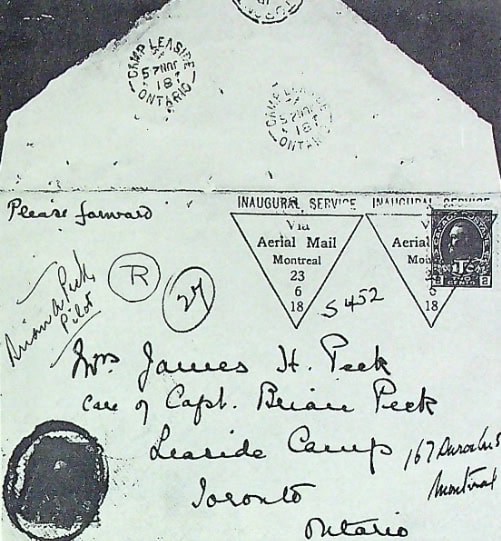
While the “Jenny” was en route from Leaside there was much activity in Montreal. As soon as the Aerial League learned that Peck was on his way, Mr. Greenwood made plans to use the opportunity for an experiment in flying the mail from Montreal to Toronto. The proposal was submitted to Dr. R. F. Coulter, the Deputy Postmaster General at Ottawa, who gave his hearty concurrence, and the necessary arrangements were quickly made with Mr. J. E. Leonard, the Montreal postmaster. A new mail bag was provided for the occasion, Mr. Greenwood was authorized to act as “aerial postmaster”, and a special cachet was prepared to cancel the stamps on the letters. Impressed on the letters in red ink, the cachet was a triangle surmounted by the words “Inaugural Service” and enclosing “by Aerial Mail, Montreal, 23-6-18”. With all arrangements completed, and numerous special letters written for the inaugural service, the Montreal newspapers on Saturday proclaimed “First Royal Mail by air tomorrow”. But both the cachet and the newspapers were in error; the arrangements had neglected to include the meteorological officials or make allowance for the vagaries of the weather. The inaugural service was 24 hours late.
MAIL TAKES WINGS
Originally scheduled for 10 o’clock Sunday morning, the return flight to Toronto had to be postponed for several hours due to pouring rain. Then, late in the afternoon, although conditions were still far from favourable a little group gathered at the Polo Grounds
to witness the historic occasion. The letters were cancelled by Mr. Greenwood, the mail bag was sealed, Peck and Mathers climbed into the cockpits of the “Jenny” and at 4.35 the aircraft took off into the lowering, rain-laden sky.
After a few minutes in the air, however, the pilot decided it was futile to continue the flight and he returned to the airfield.
At 10.12 the next morning (24 June) Peck set out again, under clearer skies, with his bag of let ters still bearing the previous day’s date. A 40-minute stop was made at Kingston2 to refuel the aircraft and its crew, and at 4.55, six hours and 43 minutes after leaving Montreal, the “Jenny” touched down at its Leaside base. Capt. Peck rushed his mail bag by car to Postmaster W. E. Lemon at the Toronto post office to have the letters postmarked again with the time of arrival. The special delivery letters in the bag were distributed the same evening, about two hours after the ‘plane landed at Leaside; the ordinary mail was delivered by the regular carrier service the next morning.

VALUABLE COVERS
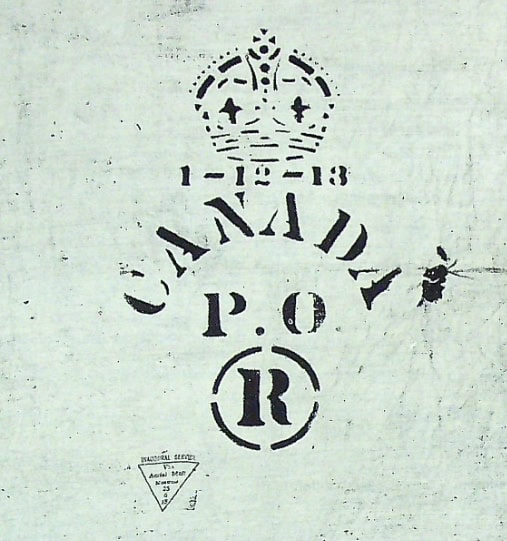
The first flight covers, about 150 in number, which Capt. Peck carried on 24 June 1918 are today valuable collector’s items. Most of the letters were apparently selected at random from the outgoing Toronto mail in the Montreal post office, but the bag also contained about two dozen letters specially written for the occasion, carrying messages of greeting from Montreal officials and business men to their “opposite numbers” in Toronto. They included letters from the mayor, postmaster and chief postal inspector, the president and officers of the Canadian Pacific and Canadian Northern Railways, the general manager of the Bank of Montreal, the chair-man of the Montreal Stock Exchange, the chairman of the Red Cross Society, the secretary of the Aerial League of the British Empire, and the editors of the local newspapers.
Toronto newspapers appeared to be slightly nettled by the fact that Montreal had “stolen a march” on the Queen City in that, although the aircraft had originally set out from Toronto, the mail was carried only one way. The Globe commented that, except for reports in the Montreal papers, “little was known in Toronto… of the unique mail service, and no arrangements were made to receive the historic mail bag”; indeed there were some doubts whether the Montreal reports had any basis in fact. Questioned by reporters, the adjutant at Leaside insisted that there was “nothing official” about the flight; Capt. Peck had merely been given permission to “drive” an aeroplane to Montreal and then had been persuaded to fly the mail back as a good will gesture. The adjutant thought the whole affair had been brought about by the newspapers. Despite his protests, the flight had been officially sanctioned by the Post Office (if not by the R.A.F.), and arrangements for it were well in hand by the time the Curtiss and its crew arrived in Montreal.
If Toronto’s “nose was out of joint” in 1918, amends were made 40 years later. In September 1958 the Archaeological and Historic Sites Board of Ontario erected a plaque on the site at Leaside where the first air mail flight in Canada had terminated. Capt. Peck, unfortunately, did not live to see the ceremony which paid tribute to his pioneer effort; he had died at Montreal two years previously on 6 September 1956.
After Capt. Peck’s flight in June 1918 had demonstrated the feasibility of air mail, the Aero Club of Canada, headed by Col. W. Hamilton Merritt, arranged another series of flights in co-operation with the Royal Air Force and the Post Office Department.
The Aero Club’s project was to institute an experimental weekly air mail service between Toronto and Ottawa, and by arrangement with the postal authorities the Club issued a special air mail sticker which was sold for the benefit of the Royal Air Force Fund for Prisoners of War. The design not too appropriate for the occasion showed a Zeppelin being shot down in flames by a biplane; around the design was the legend “The Aero Club of Canada’s first aerial mail service per Royal Air Force” with the date August 1918 and the fee 25 cents. In addition to the Aero Club sticker, placed on the back of the envelope, the letters carried the normal postage rate of 3 cents, plus special delivery if desired.

EXPERIMENTAL RUNS
The first flight in this experimental service was made on 15 August 1918 when Lt. Tremper Longman of No. 78 Canadian Training Squadron carried a small cargo of air mail from Leaside to Rockcliffe in five hours. Cancelled in the Toronto post office at 9 a.m., the bag of some 60 letters, mostly official correspondence to government offices in Ottawa, was rushed to the airfield where Longman took off an hour later. After refuelling at Deseronto, he landed on the rifle range at Rockcliffe at 3 p.m. and the mail bag was delivered to the post office in Ottawa half an hour later. Some of the letters were received by officers of the Department of Militia and Defence at 4.30 the same afternoon.3 Two days later Longman made the return trip to Toronto, leaving Rockcliff e at 6.50 a.m. on the 17th and landing at Leaside at 12.25, after the customary refuelling stop at Deseronto. The mail carried on the “Jenny” was delivered in Toronto an hour later.
The second flight in the series between the provincial and federal capitals was carried out by Lt. Arthur M. Dunstan who made the eastward trip with 130 letters on 26 August, and the return trip the next afternoon. The experimental service ended on 4 September with 26 August, and the return trip the next afternoon. The experimental service ended on 4 September with a round-trip flight between the two cities by Lt. E. C. G. Burton. Leaving Leaside at 8 a.m., he reached Rockcliffe at 12.42, had a hurried lunch and took off again an hour later. Delayed by head winds on the return flight, he did not arrive at Leaside until 7 p.m. with his cargo of 118 ordinary and 18 special delivery letters. This small bag was the “heaviest” mail carried on the experimental service operated by the Aero Club of Canada between Toronto and Ottawa.
Footnotes:
- A later account of the flight puts forward another objective to provide the camp quartermaster at Leaside with a supply of liquor for his wedding reception. According to this story, the Curtiss on its return trip from Montreal carried not only the mail bag but also a case of whisky. Naturally, contemporary reports make no mention of any aerial liquor-running. ↩︎
- Contemporary reports mention only one intermediary stop at Kingston. A later account of the flight states that Peck landed at Kingston almost out of fuel, and had to accept ordinary automobile gas as no aviation spirit was available; he then flew on to the training camp at Deseronto, drained out the auto fuel, filled up with aviation gas and continued on his way to Leaside. ↩︎
- Replies to these official letters, despatched by rail that night, reached Toronto at 8 a.m. the following morning, less than 24 hours after the original mail had closed there. This combined air-rail service cut ten hours off the 33 hours required for all-rail transport of the mail. ↩︎